lunes, 30 de noviembre de 2020

New story in Science and Health from Time: China Is Poised to Bring Home Moon Samples in its Most Ambitious Lunar Mission Yet China Is Poised to Bring Home Moon Samples in its Most Ambitious Lunar Mission Yet


The moon’s Ocean of Storms was once a busy place. Back in 1967, the U.S. successfully landed its Surveyor 3 spacecraft in the vast plain in the northern lunar hemisphere; little more than two years later, the Apollo 12 crew returned, touching down within 200 meters (656 ft.) of the Surveyor and collecting more than 34 kg (75 lbs.) of lunar rock and soil to bring back to Earth. But things have been quiet in the Ocean of Storms since—until now.

Nearly 50 years after the U.S. abandoned its lunar dreams, China’s Chang’e 5 spacecraft is set for a Dec. 1 landing in NASA’s long-ago stomping grounds, attempting to become the first country to return any samples from the moon since the Soviet Union’s robotic Luna 24 spacecraft retrieved 170 grams (6 oz.) of lunar soil in 1976. If Beijing succeeds—and its lunar endeavors to date suggest it will—it could portend big things for a country that has fast become one of the world’s leading space powers.

It was at 4:30 a.m. local time on Nov. 24 that Chang’e 5 lifted off aboard a 20-story tall Long March 5 rocket—a launch that was broadcast live across China, “leaving many spectators…in awe and excitement as the gigantic booster thundered skyward,” the China National Space Administration’s official announcement read. That sort of success has been true of all of China’s recent lunar missions. In 2007 and 2010, Chang’e 1 and Chang’e 2 successfully executed lunar orbital missions. In 2013, Chang’e 3 landed on the moon and deployed a small rover. And in 2019 Chang’e 4 did the same, becoming the first spacecraft to touch down on the far side of the moon.

Chang’e 5 will be a landing mission too—but an order of magnitude more difficult than its predecessors. The 8.2 metric ton spacecraft is actually a four-part ship: an orbiter, a lander, an ascent stage and a reentry capsule. On Nov. 28, after a four-day translunar journey, the entire assembly entered an eight-hour elliptical orbit around the moon. It later conducted an engine burn to lower itself into a circular 200 km (120 mile) orbit—about twice the altitude at which the Apollo spacecraft used to fly.

The lander and the ascent stage have since separated from the rest of the craft and the plan for Dec. 1 involves an extensive engine burn that will bring them to a soft touchdown touch down near Mons Rümker, a volcanic formation in the Ocean of Storms that features relatively young and pristine soil—with relatively the key word. The scarcity of craters on the formation suggest that the area is about 2 billion years old, less than half of the moon’s estimated 4.5 billion year-old age.

The lander will spend less than two weeks there, excavating as deep as two meters (about 6.5 ft.) below the surface, and collecting up to 2 kg (about 4.4 lbs.) of rock and soil. Those samples will then be packed into to the ascent vehicle, which will lift off and rendezvous with the orbital segment still circling the moon. The samples will then be transferred to the re-entry vehicle which will separate from the orbiter and peel off for Earth, aiming for a landing in Inner Mongolia sometime in mid-December.

In some ways the final stage of the mission—the reentry through Earth’s atmosphere—will be the most hair-raising. Spacecraft that are orbiting the Earth fly at about 28,200 km/h (17,500 mph) and can more or less ease back into the atmosphere by tapping the brakes and slowing their speed. Spacecraft returning from the moon slam into the atmosphere at a much faster 40,200 km/h and must fly in a sort of roller coaster trajectory as they descend, bleeding off speed and g-forces if they are going to survive the intense heat of reentry.

If Chang’e 5 indeed succeeds in that final step, it will open the door to robotic, sample-return mission from Mars—and, eventually, crewed missions to the moon. Pei Zhaoyu, deputy director of China’s Lunar Exploration and Space Engineering Center, sees the robotic lunar program continuing even after taikonauts—or China’s astronauts—reach the moon. “I think future exploration activities on the moon are most likely to be carried out in a human-machine combination,” he said in a press statement before the launch.

The exact nature of those future missions might be uncertain at the moment, but the likelihood that they will take place is much less so. China—like the U.S. in the 1960s—has made a commitment to the moon. And like the U.S. in the 1960s, it seems determined to make good on it.

martes, 24 de noviembre de 2020

New story in Science and Health from Time: For Much of the U.S., Good Weather Will Allow for an Outdoor (and Safer) Thanksgiving For Much of the U.S., Good Weather Will Allow for an Outdoor (and Safer) Thanksgiving


Public-health officials have for weeks been urging Americans to avoid gathering for Thanksgiving this year, lest the holiday turn into a national super-spreading event. But for those who still plan on getting together, experts say an outdoor get-together is far safer than prolonged time indoors, where it’s easier for the virus that causes COVID-19 to spread. Whether an outdoor Thanksgiving is really feasible, however, largely depends on, well, the weather.

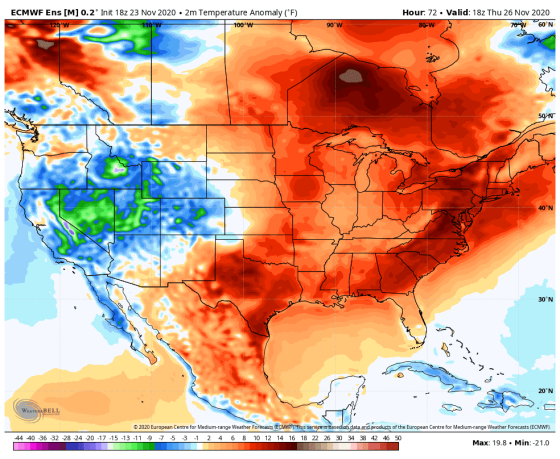
Good news: a look at the Thanksgiving Day forecast reveals that, for most of the U.S., temperatures will be above normal and the skies will be clear.

“When it comes to Thanksgiving weather, most of the country will have lucked out,” says John Homenuk, a meteorologist at New York Metro Weather, via email. “Warmer than normal air and calm conditions are expected from the Plains states to the Great Lakes and Tennessee Valley. Cooler, but mostly pleasant weather is also expected in the Pacific Northwest down the West Coast to the Desert Southwest. Outdoor activities should at least be possible in many of these regions, but especially the Central U.S. and Ohio Valley, where temperatures are expected to be several degrees warmer than normal.”

Homenuk also sent along this map, which shows expected temperatures across the U.S. in terms of how far above or below normal they’re expected to be for this time of year:

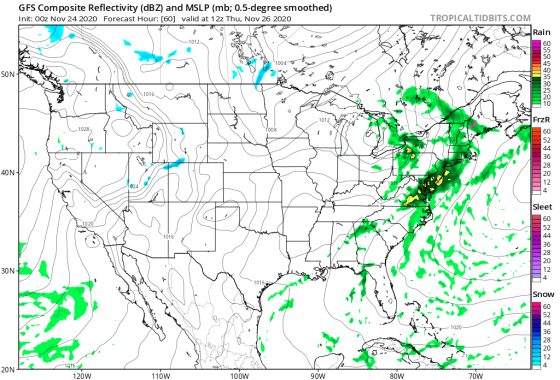
However, an outdoor Thanksgiving may be less of an option across much of the U.S. East Coast, which is likely in for some wet weather. “Areas like Philadelphia, New York City and Boston are likely to be dealing with showers and dreary conditions throughout the morning and early afternoon,” says Homenuk. “Some clearing is possible later in the day if a cold front can sweep through quickly enough.”

Even with this weather forecast in mind, it’s still safer to avoid gathering this year with anybody you don’t already live with (and no, getting a single COVID-19 test can’t guarantee a safe Thanksgiving). But if you’re committed to having people over or heading somewhere else despite the risks, it’s looking like turkey al fresco will be a viable option for many.

Still, it’s wise to keep the guest list as short as possible and ensure everybody stays masked and distanced as much as possible; it’s especially important to keep people apart while they’re masks-down and eating. One other suggestion: rather than inviting a bunch of people over for an all-day hang and dinner, have a smaller group over for a distanced outdoor hangout for part of the day, then do dinner with your immediate household later.

lunes, 23 de noviembre de 2020

New story in Science and Health from Time: China Launches a Mission to Bring Back Material From the Moon China Launches a Mission to Bring Back Material From the Moon


WENCHANG, China — China launched an ambitious mission on Tuesday to bring back rocks and debris from the moon’s surface for the first time in more than 40 years — an undertaking that could boost human understanding of the moon and of the solar system more generally.

Chang’e 5 — named for the Chinese moon goddess — is the country’s boldest lunar mission yet. If successful, it would be a major advance for China’s space program, and some experts say it could pave the way for bringing samples back from Mars or even a crewed lunar mission.

The four modules of the Chang’e 5 spacecraft blasted off at just after 4:30 a.m. Tuesday (2030 GMT Monday, 3:30 p.m. EST Monday) atop a massive Long March-5Y rocket from the Wenchang launch center along the coast of the southern island province of Hainan.

Minutes after liftoff, the spacecraft separated from the rocket’s first and second stages and slipped into Earth-moon transfer orbit. About an hour later, Chang’e 5 opened its solar panels to provide its independent power source.

Spacecraft typically take three days to reach the moon.

The launch was carried live by national broadcaster CCTV which then switched to computer animation to show its progress into outer space.

The mission’s key task is to drill 2 meters (almost 7 feet) beneath the moon’s surface and scoop up about 2 kilograms (4.4 pounds) of rocks and other debris to be brought back to Earth, according to NASA. That would offer the first opportunity for scientists to study newly obtained lunar material since the American and Russian missions of the 1960s and 1970s.

The Chang’e 5 lander’s time on the moon is scheduled to be short and sweet. It can only stay one lunar daytime, or about 14 Earth days, because it lacks the radioisotope heating units to withstand the moon’s freezing nights.

The lander will dig for materials with its drill and robotic arm and transfer them to what’s called an ascender, which will lift off from the moon and dock with the service capsule. The materials will then be moved to the return capsule to be hauled back to Earth.

The technical complexity of Chang’e 5, with its four components, makes it “remarkable in many ways,” said Joan Johnson-Freese, a space expert at the U.S. Naval War College.

“China is showing itself capable of developing and successfully carrying out sustained high-tech programs, important for regional influence and potentially global partnerships,” she said.

In particular, the ability to collect samples from space is growing in value, said Jonathan McDowell, an astronomer at the Harvard-Smithsonian Center for Astrophysics. Other countries planning to retrieve material from asteroids or even Mars may look to China’s experience, he said.

While the mission is “indeed challenging,” McDowell said China has already landed twice on the moon with its Chang’e 3 and Chang’e 4 missions, and showed with a 2014 Chang’e 5 test mission that it can navigate back to Earth, re-enter and land a capsule. All that’s left is to show it can collect samples and take off again from the moon.

“As a result of this, I’m pretty optimistic that China can pull this off,” he said.

Read more: China is Quickly Becoming a Space Superpower

The mission is among China’s boldest since it first put a man in space in 2003, becoming only the third nation to do so after the U.S. and Russia.

Chang’e 5 and future lunar missions aim to “provide better technical support for future scientific and exploration activities,” Pei Zhaoyu, mission spokesperson and deputy director of the Chinese National Space Administration’s Lunar Exploration and Space Engineering Center told reporters at a Monday briefing.

“Scientific needs and technical and economic conditions” would determine whether China decides to send a crewed mission to the moon, said Pei, whose comments were embargoed until after the launch. “I think future exploration activities on the moon are most likely to be carried out in a human-machine combination.”

While many of China’s crewed spaceflight achievements, including building an experimental space station and conducting a spacewalk, reproduce those of other countries from years past, the CNSA is now moving into new territory.

Chang’e 4 — which made the first soft landing on the moon’s relatively unexplored far side almost two years ago — is currently collecting full measurements of radiation exposure from the lunar surface, information vital for any country that plans to send astronauts to the moon.

China in July became one of three countries to have launched a mission to Mars, in China’s case an orbiter and a rover that will search for signs of water on the red planet. The CNSA says the spacecraft Tianwen 1 is on course to arrive at Mars around February.

China has increasingly engaged with foreign countries on missions, and the European Space Agency will be providing important ground station information for Chang’e 5.

U.S. law, however, still prevents most collaborations with NASA, excluding China from partnering with the International Space Station. That has prompted China to start work on its own space station and launch its own programs that have put it in a steady competition with Japan and India, among Asian nations seeking to notch new achievements in space.

China’s space program has progressed cautiously, with relatively few setbacks in recent years. The rocket being used for the current launch failed on a previous launch attempt, but has since performed without a glitch, including launching Chang’e 4.

“China works very incrementally, developing building blocks for long-term use for a variety of missions,” Freese-Johnson said. China’s one-party authoritarian system also allows for “prolonged political will that is often difficult in democracies,” she said.

While the U.S. has followed China’s successes closely, it’s unlikely to expand cooperation with China in space amid political suspicions, a sharpening military rivalry and accusations of Chinese theft of technology, experts say.

“A change in U.S. policy regarding space cooperation is unlikely to get much government attention in the near future,” Johnson-Freese said.

viernes, 20 de noviembre de 2020

New story in Science and Health from Time: Exclusive: Pfizer CEO Discusses Submitting the First COVID-19 Vaccine Clearance Request to the FDA Exclusive: Pfizer CEO Discusses Submitting the First COVID-19 Vaccine Clearance Request to the FDA


On Friday, Pfizer CEO and chairman Albert Bourla announced that the company has filed a request to the U.S. Food and Drug Administration (FDA) for emergency use authorization of its COVID-19 vaccine, making it the first to do so. In a discussion on TIME 100 Talks, Bourla says that if the FDA authorizes the vaccine, the company will be ready “within hours” from receiving the green light to start distributing the vaccine. Pfizer has been manufacturing doses even while safety and efficacy tests were ongoing, in order to avoid delays in shipping once authorized.

According to Bourla, Pfizer is on “on track” to deliver the 50 million doses promised to the U.S. government by the end of the year, with 1.3 billion doses through next year.

In an in-depth conversation about the journey the company has taken in developing its vaccine, Bourla admitted that, throughout the process, he wasn’t always sure that having a safe and effective vaccine ready for FDA review in less than a year was possible. “Conviction is a part of it, so I was always telling [our teams] that we will make it, and we will make it by October, and if not us, then who?” he says. “But I knew that it was an extremely risky suggestion, I knew it was going to be difficult, and the stars needed to be aligned all the way to the end.”

Pfizer capitalized on a partnership begun in 2018 with German company BioNTech, which was founded by a husband-and-wife team of scientists with expertise in a genetic technology called mRNA. The platform is fast and flexible for developing vaccines, since it only requires knowing the genetic sequence of the virus the vaccine will target, rather than growing and manipulating the virus in question.

Still, no mRNA-based vaccine against an infectious disease had ever been approved, so Pfizer and BioNTech began exploring whether influenza might be the first. Instead, when the pandemic hit a year later, the teams shifted their attention to SARS-CoV-2, the novel coronavirus that causes COVID-19, with surprising success. Bourla says the partnership is built on a mutual focus on advancing science, and that the two companies began work, including sharing confidential information, before signing a formal contract, since those agreements can take months. “In fact, we are still finalizing the contractual obligations we have that we need to sign with them,” says Bourla. “It’s the perfect relationship for me. Ugur [Sahin, BioNTech’s co-founder and chief executive] is a wonderful human being, and a great scientist. He shares the same passion [as I do] about saving lives and I’m very optimistic that not only will we do very well together bringing a COVID-19 vaccine to the world, but later hopefully a flu vaccine.”

Bourla also believes the success of the Pfizer/BioNTech vaccine, as well as that of Massachusetts-based biotech Moderna (which also has an mRNA COVID-19 vaccine candidate, shown to be 94.5% effective) validates the mRNA platform, and makes it a serious contender for future vaccines and drugs against emerging infectious diseases. That validity of mRNA vaccines will be further tested once their efficacy can be compared to those of other vaccines that use the more proven methods of relying on weakened cold viruses to deliver viral material to the immune system, or selected fragments of viral proteins.

While he expressed concern about the skepticism and mistrust that many American have expressed about the COVID-19 vaccines, mostly because they were developed so quickly, Bourla says he hopes the completion of the election and the magnitude of the efficacy and safety data start to reassure people. “The problem is that this vaccine, and the pandemic in general, became the focal point of political debate,” he says. “It was discussed in political rather than scientific terms. We reached an unthinkable point that wearing a mask is a political statement, which I think is wrong. Wearing a mask is something you need to do because science is telling you to do it.”

He noted that in an effort to reassure the public about the scientific integrity of the vaccine development and testing process, vaccine makers in the pharmaceutical industry came together in an unprecedented show of support against political pressure by pledging to stick to scientific standards and nothing else. “Myself, I released a lot of letters saying I will never succumb to any political pressure,” he says. “The only pressure we feel at Pfizer is the pressure 7 billion people around the world are giving us for a solution to this pandemic.”

Vaccine makers are a little less united on the question of whether they should profit from a pandemic shot. While some have said they will price their vaccines so they don’t profit from them, Bourla says Pfizer is making its vaccine available on a non-for-profit basis only for lower-income countries receiving vaccines through the World Health Organization vaccine distribution coalition run by GAVI. “We have elected for developed countries, to give [the vaccine] at a very low price [around $19.50]. We believe the price allows governments all over the world to give the vaccine free to their citizens,” he says. “If you think about the economic value of a vaccine—I’m not speaking about the human value because there is no way to measure human life—I think the millions of jobs that will not be lost, that hopefully will come back, and the billions in economic value that a successful vaccine will enable—I think it’s not appropriate to discuss if we sell it at $19.50 per dose.”

Bourla would not speculate on how long the FDA might take to decide on the company’s EUA request, but given the urgency of the pandemic, that decision could come soon. The agency will likely take into consideration the fact that the vaccine’s 95% effectiveness is in protecting against COVID-19 disease—not preventing infection from the virus. But with cases of COVID-19 continuing to surge around the world, stalling the virus and preventing people from getting sick would be a welcome advantage. More studies will also explore whether people who don’t become sick because they are vaccinated are less likely to spread infection; if that’s the case then the vaccines will be even more critical for controlling the pandemic.

“I hope the same time next year, we will be in a very, very different place,” he says. “When you have vaccine protection that is that high, 95% for example”—the effectiveness level Pfizer’s vaccine has shown in studies—”it takes less time to be able to develop protection through a vaccination scheme. So I truly believe the light at the end of the tunnel is not only real but it is bright and is coming. We need to be patient.”

jueves, 19 de noviembre de 2020

New story in Science and Health from Time: The Renowned Arecibo Radio Telescope in Puerto Rico Is to Close in a Blow to Science The Renowned Arecibo Radio Telescope in Puerto Rico Is to Close in a Blow to Science


SAN JUAN, Puerto Rico — The National Science Foundation announced Thursday that it will close the huge telescope at the renowned Arecibo Observatory in Puerto Rico in a blow to scientists worldwide who depend on it to search for planets, asteroids and extraterrestrial life.

The independent, federally funded agency said it’s too dangerous to keep operating the single dish radio telescope — one of the world’s largest — given the significant damage it recently sustained. An auxiliary cable broke in August and tore a 100-foot hole in the reflector dish and damaged the dome above it. Then on Nov. 6, one of the telescope’s main steel cables snapped, leading officials to warn that the entire structure could collapse.

NSF officials noted that even if crews were to repair all the damage, engineers found that the structure would still be unstable in the long term.

“This decision is not an easy one for NSF to make, but the safety of people is our number one priority,” said Sean Jones, the agency’s assistant director for the Mathematical and Physical Sciences Directorate. “We understand how much Arecibo means to this community and to Puerto Rico.”

He said the goal was to preserve the telescope without placing people at risk, but, “we have found no path forward to allow us to do so safely.”

The telescope was built in the 1960s with money from the Defense Department amid a push to develop anti-ballistic missile defenses. In its 57 years of operation, it endured hurricanes, endless humidity and a recent string of strong earthquakes.

The telescope boasts a 1,000-foot-wide (305-meter-wide) dish featured in the Jodie Foster film “Contact” and the James Bond movie “GoldenEye.” Scientists worldwide have used the dish along with the 900-ton platform hanging 450 feet above it to track asteroids on a path to Earth, conduct research that led to a Nobel Prize and determine if a planet is potentially habitable.

In recent years, the NSF-owned facility has been managed by the University of Central Florida.

Alex Wolszczan, a Polish-born astronomer and professor at Pennsylvania State University who helped discover the first extrasolar and pulsar planets, told The Associated Press that while the news wasn’t surprising, it was disappointing. He worked at the telescope in the 1980s and early 1990s.

“I was hoping against hope that they would come up with some kind of solution to keep it open,” he said. “For a person who has had a lot of his scientific life associated with that telescope, this is a rather interesting and sadly emotional moment.”

The announcement saddened many beyond the scientific world as well, with the hashtag #WhatAreciboMeansToMe popping up on Twitter along with pictures of people working, visiting and even getting married or celebrating a birthday at the telescope.

Ralph Gaume, director of NSF’s Division of Astronomical Sciences, stressed that the decision has nothing to do with the observatory’s capabilities, which have allowed scientists to study pulsars to detect gravitational waves as well as search for neutral hydrogen, which can reveal how certain cosmic structures are formed.

“The telescope is currently at serious risk of unexpected, uncontrolled collapse,” he said. “Even attempts at stabilization or testing the cables could result in accelerating the catastrophic failure.”

Officials suspect a potential manufacturing error is to blame for the auxiliary cable that snapped after a socket holding it failed, but say they are surprised that a main cable broke about three months later given that it was supporting only about 60% of its capacity. Engineers had assessed the situation after the first cable broke, noting that about 12 of the roughly 160 wires of the second cable that eventually broke had already snapped, said Ashley Zauderer, program officer for Arecibo Observatory at NSF.

“It was identified as an issue that needed to be addressed, but it wasn’t seen as an immediate threat,” she said.

She and other NSF officials said that all standard maintenance procedures had been followed.

The closure is a blow for many of the more than 250 scientists that have used a telescope that is also considered one of Puerto Rico’s main tourist attractions, drawing some 90,000 visitors a year. It also has long served as a training ground for hundreds of graduate students.

“It was my Disney,” wrote Edgard Rivera-Valentín, a Universities Space Research Association scientist at the Lunar and Planetary Institute in Texas, in a series of tweets. He recalled first visiting when he was 4 or 5.

“Think about what the Golden Gate Bridge means to San Francisco, Statue of Liberty to New Yorkers. Arecibo is this and more to Puerto Rico because it has gone beyond an icon.”

The NSF said it intends to restore operations at the observatory’s remaining assets including its two LIDAR facilities, one of which is located in the nearby island of Culebra. Those are used for upper atmospheric and ionospheric research, including analyzing cloud cover and precipitation data. Officials also aim to resume operations at the visitor center.

Wolszczan, the astronomer, said the value of the telescope won’t instantly disappear because he and many other scientists are still working on projects based on observations and data taken from the observatory.

“The process of saying goodbye to Arecibo will certainly take some years,” he said. “It won’t be instantaneous.”

New story in Science and Health from Time: COVID-19 Vaccines Are Coming. Here’s What to Expect COVID-19 Vaccines Are Coming. Here’s What to Expect


Vaccines normally take decades to develop and test, but two COVID-19 shots, from Moderna and Pfizer (in partnership with BioNTech), have gone from nonexistent to about 95% effectiveness in 10 months. Public-health officials and governments now have the dual challenge of convincing the public that the vaccines are both safe and scientifically sound, as well as figuring out how to distribute billions of doses. Here’s what we know so far about how that’s going.

When can I get vaccinated?

That depends.

Manufacturers have already begun producing vaccines, betting that they will be effective, so they can be ready to ship if the FDA authorizes them, possibly as soon as December. Still, doses will be limited this year and will be reserved for those at highest risk of infection, such as health care workers as well as those with essential jobs, like first responders and law-enforcement personnel. As vaccine manufacturers fire up production, more people, including those with chronic health conditions, and the elderly, will be able to get immunized. Dr. Anthony Fauci, director of the National Institute of Allergy and Infectious Diseases, says it may not be until spring that most Americans can start to get vaccinated.

Who approves the vaccines?

The Food and Drug Administration must approve any vaccine. But most COVID-19 vaccine makers won’t initially apply for normal approval, which typically requires six or more months of follow-up study. Instead, they will likely ask for emergency-use authorization (EUA), which makes it possible to release new drugs and vaccines during a health emergency. For an EUA, the FDA has said companies should monitor trial participants for two months to make sure the vaccines are safe and don’t lead to serious side effects. All of the testing and other requirements for evaluating safety and effectiveness remain the same for an EUA as for full approval. Many vaccine makers plan to apply for full approval of their shots once they accumulate the appropriate amount of follow-up data.

Were shortcuts taken to develop these vaccines?

According to leading public-health experts and the vaccine makers, the same rigorous scientific process that goes into developing any vaccine was used to create the COVID-19 shots. But in some cases, new technology like the mRNA-based technique used by Moderna and Pfizer—the first two companies to finish human testing—have sped up the development process. The mRNA method doesn’t require researchers to grow or manipulate SARS-CoV-2, the virus responsible for COVID-19; all they need is its genetic sequence, which Chinese scientists released in January. The technology is both fast and flexible, and allowed vaccine makers to develop and start testing their vaccines in a matter of months.

If I get vaccinated, does that mean that I can’t get infected?

Not necessarily.

But it means you are less likely to get sick. When Pfizer announced that its vaccine was more than 95% effective and Moderna said its shot was 94.5% effective, that was how well they kept people from getting sick. In the studies, people were randomly assigned to get the vaccine or a placebo. If anyone in either group felt symptoms of COVID-19 (including fever, cough, headache and difficulty breathing), they reported it to the researchers, who then decided whether to test for COVID-19. So the studies did not test everyone to see how many people in the vaccinated group got infected compared with the placebo group. Instead, the scientists took those participants who tested positive for COVID-19 and compared how many in the vaccinated group went on to develop disease and how many in the placebo group did. The companies will continue to test people in the studies for antibodies to the COVID-19 virus, which would include people who did not show any symptoms of their infection, so they can get a better sense of whether or not the vaccines protect against not only getting sick but also against infection.

Are all the vaccines made the same way?

No.

The various companies are relying on different technologies. Moderna and Pfizer use the mRNA technology based on the pandemic virus’s genetic code. The AstraZeneca and University of Oxford team, as well as Johnson & Johnson/Janssen, are relying on different inactivated cold viruses loaded with COVID-19 viral genes that can produce viral proteins to activate the immune system, while both Novavax and the Sanofi/GlaxoSmithKline partnership are producing and then introducing proteins from the virus itself to trigger an immune response. All are close to completing testing of their shots.

Where can I get vaccinated?

In the first few months after the initial doses are shipped, there will likely be a limited number of ­providers—mostly in public-health clinics and major hospitals. But the federal government has authorized pharmacists to administer COVID-19 vaccines, so eventually retail pharmacies, community health centers and other locations will be offering COVID-19 shots.

Can I choose which vaccine I get?

Probably not.

State health departments will likely be coordinating the ordering and distribution of doses, and they won’t know which vaccines they will receive. Some health departments may request certain vaccines depending, for example, on factors such as whether some of their vaccine facilities have the proper storage equipment like the ultra-cold freezers needed for Pfizer’s vaccine, or perhaps whether the shots show any differences in effectiveness among people of different ages, ethnicities or health conditions. So far, the Moderna and Pfizer vaccines don’t show such distinctions, so they will likely be shipped out based on proposals that state health departments have submitted for how many doses they will need. Although Pfizer’s vaccine needs to be stored at –70°C, the company plans to ship its doses in thermal packaging that can maintain that temperature for up to 15 days, as long as users replenish the dry ice included in the packaging.

Why do I need two doses of vaccine?

All of the COVID-19 vaccines being tested, with the exception of Johnson & Johnson/Janssen’s, require two doses. That’s because researchers found that while the body launches an immune response after the first dose, boosting that initial exposure to the virus magnifies that defense significantly. If a person hasn’t been infected by the COVID-19 virus, it takes a little longer to prime the pump of their immune system against it.

Will I have to pay for a COVID-19 vaccine?

Vaccines supported by U.S. taxpayer dollars under the Operation Warp Speed ­program—which includes those from AstraZeneca, Johnson & Johnson/Janssen, Moderna, Pfizer/BioNTech, Sanofi/GlaxoSmithKline and others—should be free for all Americans, although the details of the purchasing contracts are still unclear. Some health facilities may also charge an administration fee for giving the vaccine, which people will have to pay out of pocket.

Will I still have to wear a mask after I get vaccinated?

Yes.

Studies so far show only that the vaccines can protect against getting sick with the disease, and may not prevent being infected with the virus. So it’s important to still follow all the public-health measures that throw up an invisible wall against the coronavirus. Even if you’re immunized, you can still get infected with the virus and therefore pass it on to others. That’s why even as more and more people get vaccinated, health officials will continue to ask you to wear a mask in public, practice social distancing and avoid large indoor gatherings. Those basic behaviors will remain critical in keeping the virus from finding new hosts.

lunes, 16 de noviembre de 2020

New story in Science and Health from Time: The SpaceX Capsule With Four Astronauts On Board Has Reached the International Space Station The SpaceX Capsule With Four Astronauts On Board Has Reached the International Space Station


CAPE CANAVERAL, Fla. — SpaceX’s newly launched capsule with four astronauts arrived Monday at the International Space Station, their new home until spring.

The Dragon capsule pulled up and docked late Monday night, following a 27-hour, completely automated flight from NASA’s Kennedy Space Center.

“Oh, what a good voice to hear,” space station astronaut Kate Rubins called out when the Dragon’s commander, Mike Hopkins, first made radio contact. The linkup occurred 262 miles (422 kilometers) above Idaho.

This is the second astronaut mission for SpaceX. But it’s the first time Elon Musk’s company delivered a crew for a full half-year station stay. The two-pilot test flight earlier this year lasted two months.

The three Americans and one Japanese astronaut will remain at the orbiting lab until their replacements arrive on another Dragon in April. And so it will go, with SpaceX — and eventually Boeing — transporting astronauts to and from the station for NASA.

This regular taxi service got underway with Sunday night’s launch.

Hopkins and his crew — Victor Glover, Shannon Walker and Japan’s Soichi Noguchi — join two Russians and one American who flew to the space station last month from Kazakhstan. Glover is the first African-American to move in for a long haul. A space newcomer, Glover was presented his gold astronaut pin Monday.

The four named their capsule Resilience to provide hope and inspiration during an especially difficult year for the whole world. They broadcast a tour of their capsule Monday, showing off the touchscreen controls, storage areas and their zero gravity indicator: a small plush Baby Yoda.

Walker said it was a little tighter for them than for the two astronauts on the test flight.

“We sort of dance around each other to stay out of each other’s way,” she said.

For Sunday’s launch, NASA kept guests to a minimum because of coronavirus, and even Musk had to stay away after tweeting that he “most likely” had an infection. He was replaced in his official launch duties by SpaceX President Gwynne Shotwell, who assured reporters he was still very much involved with Sunday night’s action, although remotely.

As they prepared for the space station linkup, the Dragon crew beamed down live window views of New Zealand and a brilliant blue, cloud-streaked Pacific 250 miles below.

“Looks amazing,” Mission Control radioed from SpaceX headquarters in Hawthorne, California.

“It looks amazing from up here, too,” Hopkins replied.

___

The Associated Press Health and Science Department receives support from the Howard Hughes Medical Institute’s Department of Science Education. The AP is solely responsible for all content.