Nobody is selling Team Bezos or Team Branson t-shirts just yet. The competition between billionaires Jeff Bezos (founder of Blue Origin) and Richard Branson (co-founder of Virgin Galactic) to see who can be first to space may never have the historical cachet of Red Sox versus Yankees, Lincoln versus Douglas, Hamilton versus Burr, but it’s a hot contest all the same. This Sunday, July 11, it could reach its pinnacle, when Branson, along with three other Virgin Galactic corporate officers and two pilots, take off aboard their VSS Unity space plane to attempt a suborbital mission that will earn all six their astronaut wings—not to mention bragging rights over Bezos, whose own flight aboard his New Shepard spacecraft is set to happen nine days later, on July 20.
[time-brightcove not-tgx=”true”]
Originally, Bezos was going to fly first, with Branson not scheduled to make his attempt until the end of the year. But on July 1, Bezos notched a public relations win when he announced that he was taking 82 year old Wally Funk—one of 13 female astronaut candidates in the 1960s, all of whom were passed over by NASA in favor of an all-male astronaut corps—on his inaugural flight with him, at last giving her a long-denied taste of space. Just hours later, Branson jumped the flight queue, announcing his earlier July 11 launch date—and, not incidentally, winning back the space race news cycle.
“I know nobody will believe me, but honestly there isn’t [any competition with Bezos],” Branson later told NBC’s Today.
Gene Blevins—AFP/Getty ImagesVirgin Galactic’s SpaceshipTwo takes off for a suborbital test flight of the VSS Unity on December 13, 2018, in Mojave, California.
Maybe, but a competition is exactly what it looks like, and there is technological and economic substance behind the rivalry. For better or worse, space tourism is likely to become a growth industry. Branson reportedly has a waiting list of more than 600 space vacationers ready to pay $250,000 each for a 15 minute ride to space. Bezos, who came to the game later, has not yet begun his marketing push, but there is little doubt that if his mission succeeds, the selling will begin.
Branson has the edge in crewed flight experience: his VSS Unity vehicle has made three successful trips to space. Blue Origin’s New Shepard has not yet carried crew, but it has made 15 uncrewed, automated suborbital flights. New Shepard takes off like a traditional rocket, with a crew capsule separating near the peak of the flight parabola, arcing into space for three minutes of weightless sightseeing, and descending by parachute, while the rocket itself lands upright. VSS Unity is a winged rocket plane, which is carried by a four-engine jet to an altitude of about 15,240 m (50,000 ft), flies the rest of the way to space under rocket power, and then lands like an airplane.
Critically—at least for that business of bragging rights—Bezos’ New Shepard will fly higher, breaking the 100 km (62 mi.) boundary known as the Von Kármán Line, which is the widely accepted definition of the threshold of space. Branson’s VSS Unity climbs only to 80 km (50 mi.) which, while lower, is the point that the U.S. military historically recognized as the space boundary for test pilots flying early X-15 rocket planes. To Blue Origin, that makes a difference. “We wish him a great and safe flight, but they’re not flying above the Kármán line and it’s a very different experience,” Blue Origin CEO Bob Smith said in an email to TIME.
Blue OriginNew Shepard lifts off on its 12th mission on December 11, 2019.
Others outside the Bezos and Branson camps don’t see much distinction. “I think if you’re leaving the atmosphere and you’re floating, you’re an astronaut,” says retired NASA astronaut and former International Space Station commander Terry Virts.
More important than the astronaut label Branson and Bezos stand to earn—and certainly more important than who flies first—is the matter of getting up and down safely. Space has always been a dangerous game. It’s true for test pilots, it’s true for tourists, it’s even true for fabulously rich men who build their own spacecraft and pay their own freight. The billionaire space race may play out like a game—but it’s a deadly serious business too.
Welcome to COVID Questions, TIME’s advice column. We’re trying to make living through the pandemic a little easier, with expert-backed answers to your toughest coronavirus-related dilemmas. While we can’t and don’t offer medical advice—those questions should go to your doctor—we hope this column will help you sort through this stressful and confusing time. Got a question? Write to us at covidquestions@time.com.
Today, N.C. in Washington, D.C., asks:
I got a Johnson & Johnson vaccine. With the Delta variant spreading, I’ve heard that some people in my position are also getting shots of Pfizer or Moderna for extra protection. Is that something I should do, too? And if booster shots become recommended later on, should I switch to Pfizer or Moderna?
It’s true that vaccines made with mRNA—those from Pfizer-BioNTech and Moderna—offer stronger protection against initial COVID-19 strains than Janssen/Johnson & Johnson’s adenovirus-based shot. That’s why some people who got Johnson & Johnson’s vaccine are interested in doubling up, particularly as the more transmissible Delta variant continues to spread in the U.S.
The U.S. Centers for Disease Control and Prevention’s (CDC) official stance is that COVID-19 shots are not interchangeable. That doesn’t necessarily mean it’s unsafe to mix them; there’re just not a lot of data available to answer the question.
Some prominent researchers have decided to forge ahead and get mRNA boosters on top of Johnson & Johnson shots, even without an official blessing from the CDC—and despite the fact that some pharmacies won’t give additional shots to people who are already fully vaccinated.
Dr. Hana Mohammed El Sahly, a molecular virology and microbiology expert at Baylor College of Medicine, is not one of those researchers—and she says she wouldn’t recommend that course of action. “Until we have better data, it probably is not wise to go and get [additional] vaccines unless it’s part of a clinical trial,” she says.
Those data are on the way. National Institutes of Health (NIH) scientists are studying what happens when people get a booster of a different vaccine than their original shot. That study includes the Johnson & Johnson vaccine.
European research teams have also published results suggesting that it’s effective to mix one dose of Pfizer-BioNTech’s vaccine with one dose of the shot made by AstraZeneca-Oxford University—which, like Johnson & Johnson’s vaccine, is adenovirus-based. That’s not a direct parallel, but it does support the general concept of mixing and matching doses. Countries including Germany, Canada and the Dominican Republic are already trying out such systems, but none of them are mixing Johnson & Johnson shots with other vaccines.
Safety aside, a second shot might not even be necessary. A new study published in Nature found that people who were only partially vaccinated (i.e., who received only one shot out of a two-dose regimen) were susceptible to the Delta variant, but that fully vaccinated individuals were much better protected. The study didn’t analyze Johnson & Johnson’s shot, but people who get the one-dose vaccine are considered fully vaccinated by the CDC.
Johnson & Johnson says its vaccine—like others authorized in the U.S.—works well against the Delta variant, although that conclusion came from a very small study. Even with the Delta variant spreading, El Sahly notes, the vast majority of people who end up hospitalized or die from COVID-19 are unvaccinated, which suggests the shots continue to work well as authorized.
If you’re concerned, El Sahly says your best bet, at least for now, is returning to precautions like masking and social distancing—not getting a second type of vaccine.
That advice may change down the road. Experts have said it’s possible that everyone will need a booster shot roughly a year after vaccination, depending on how long they provide protection against the virus. By the time health officials know whether boosters are necessary, El Sahly says, researchers will hopefully have gathered enough data to make a recommendation about whether you should stick with Johnson & Johnson or switch to Pfizer-BioNTech or Moderna.
And if you’re absolutely desperate to get double-vaccinated in the meantime, the NIH’s study on mix-and-match dosing is enrolling now. “You can volunteer there and help us generate those data,” El Sahly says.
As a heatwave continues to cook the Pacific Northwest of the United States this week, heat records have fallen like dominos throughout the rest of the northern hemisphere. Even the United Nation’s World Meteorological Organization (WMO), which registers global temperature extremes, admitted that it was having trouble keeping up. “So many records have been broken that it is difficult to keep track,” the organization wrote in its latest report on exceptional heat. Seattle set an all-time record of 104°F (40°C) on June 27, then immediately broke it the next day, with a high of 107°F (41.7°C). Portland hit 112°F (44.4°C). Last Wednesday, the Canadian mountain town of Lytton broke the country’s all-time record, reaching 121.3°F (49.6 °C), a temperature I last experienced when reporting in Jacobabad, Pakistan, long considered to be one of the hottest cities on earth.
[time-brightcove not-tgx=”true”]
Indeed, the latest report from the European Union’s Copernicus Climate Change service, which tracks global temperatures using billions of measurements taken from around the world, confirms what we already know: June 2021 was the warmest June recorded in North America.
The fact that the hottest northern hemisphere Junes have all happened in the past six years gives us a pretty good indication of where things are going next.
As the WMO seeks to verify reports of the highest-ever temperature north of the Arctic Circle since records there began—100.4°F (38°C) in the Siberian town of Verkhoyansk—North Africa, the Middle East, eastern Europe and northern India are all experiencing temperatures significantly above average for extended periods of time.
Of course, single-day spikes, heat waves and heat domes are weather, not climate. But these early summer extremes are taking place against the backdrop of human-induced climate change. Average global temperatures are already 1.2°C higher than pre-industrial levels. “Heatwaves are becoming more frequent and intense as greenhouse gas concentrations lead to a rise in global temperatures,” says Omar Baddour, head of the WMO’s Climate Monitoring and Policy Division. “We are also noticing [that] they are starting earlier and ending later and are taking an increasing toll on human health.” Think of those extra degrees as putting weather on stilts: the temperatures go higher, and everything is less stable.
In some cases, literally.
Consistent above-average temperatures in the Russian arctic are contributing to the melting of permafrost—the year-round frozen ground that defines the region. As the once solid ground degrades into soft soil, buildings and infrastructure like roads and electrical lines start to collapse. Aleksandr Kozlov, Russia’s Minister of Natural Resources, told a minister’s council in May that more than 40% of the northern region’s buildings are starting to deform. Nearly 30% of oil and gas installations are inoperable. By 2050, Russian researchers estimate that the melting permafrost will inflict damages worth about $69 billion, about a quarter of the current Russian federal budget.
On the other side of the arctic, near Greenland, polar bears and other arctic wildlife are also starting to feel the heat. A study published last week in the journal CommunicationsEarth & Environment finds that a formally reliable bank of sea ice in the Wandel Sea is now under threat. The region was once known to scientists as the “last ice area” for its thick, year-round plates of ice critical for the survival of polar bears, seals and walruses. But when a German research vessel reached the area during the course of an arctic transit last summer, the captain encountered wide swaths of open water in a sobering preview of ice-free arctic summers to come.
Computer modeling suggests that by the end of the century these temperature extremes will become the norm. And more heat means more deaths. The heatwave in the Pacific Northwest has already claimed hundreds of lives; a May study published in the journal Nature Climate Change found that 37% of heat-related deaths could be linked to climate change, with some scientists projecting that by 2100 the number of annual heat deaths could match those from infectious disease. But that is only if nothing is done. A 2019 study in Science Advances showed that deaths from heat waves could be substantially reduced if the world reduces its greenhouse gas emissions enough to meet the Paris climate agreement goals.
This most recent heat bomb may just provide the right incentive for policy makers and citizens to reach that goal—with a caveat: a survey of American adults conducted by the University of Michigan and Muhlenberg College in the wake of a May 2018 heat wave showed a record level of acceptance that global warming is caused by human activity. Still, a 2021 survey in the same series demonstrated that while 60% of Americans are linking record warmth to the broader effects of human-induced global warming, only 10% believe that reducing greenhouse gas emissions is the best way to combat it.
Unless attitudes change, record heat won’t either.
Jane Gilbert knows she doesn’t get the worst of the sticky heat and humidity that stifles Miami each summer. She lives in Morningside, a coastal suburb of historically preserved art deco and Mediterranean-style single-family homes. Abundant trees shade the streets and a bay breeze cools residents when they leave their air conditioned cars and homes. “I live in a place of privilege and it’s a beautiful area,” says Gilbert, 58, over Zoom in early June, shortly after beginning her job as the world’s first chief heat officer, in Miami Dade county. “But you don’t have to go far to see the disparity.”
[time-brightcove not-tgx=”true”]
A mile or two inland, in lower income, mostly Black and Latino neighborhoods like Little Haiti, Little Havana and Liberty City, tree cover can be as little as 10%, compared to around 40% in upscale coastal areas, according to Gilbert. Residents wait for buses on unshaded benches. Many can’t afford to buy or run an AC unit. “You can’t be outside for more than five minutes without feeling faint because there’s no shade. Then inside a lot of homes, the buildings haven’t been fixed up in a very long time, so you get holes in the wall and mold,” says Stibalys Gomez, a 24-year-old community organizer and amateur boxer. “We have a lot of older people here, older Hispanics with respiratory problems, including my grandmother. I’m really worried about them this summer.”
As the climate changes, everyone is feeling the heat. A historical heatwave continues to rage across the western U.S., while in Miami, the heat index—which accounts for heat and humidity—was higher in June than in any month since August 2015. It’s not just a nuisance. Extreme heat contributed to the deaths of around 12,000 people in the U.S. each year between 2010 and 2020, according to a study by the University of Washington—more than any other extreme weather event. By 2100, the annual toll could be as high as 97,000.
In cities, though, how you experience all of those impacts depends on your race and your zip code. According to a study published in the journal Nature in May, Black and Hispanic residents of U.S. cities are around twice as exposed as white people to the “urban heat island effect”—where paved streets and buildings absorb more heat than grass and trees would, driving the temperature up compared to surrounding areas. People living below the poverty line are 50% more exposed to the heat island effect than wealthier people.
Gilbert’s job is to redress those imbalances in Miami and get all areas of the local government working towards a cooler county. Working under Mayor Daniella Levine Cava, she’ll plant new trees, create better infrastructure for heat emergencies, and inform people about their needs and rights during the heat.
The heat officer role—which will also be adopted soon by Athens, Greece and Freetown, Sierra Leone—reflects a reckoning on heat unfolding in cities across the world. Local leaders are trying to escape reliance on AC—responsible for a significant share of cities’ greenhouse gas emissions—and find fairer, more sustainable solutions. Paris is ripping up rock and asphalt surfaces in the city center to replace them with urban forests. Montreal is campaigning for residents to check in on neighbors during heatwaves. Cities in India are taking part in a national competition to drive the construction of thousands of heat-reflecting cool roofs on buildings in informal neighborhoods. “Before, heat was something many of these cities had to deal with once or twice a year and now it’s something they have to be able to manage regularly,” says Laurian Farrel, North America director at the Resilient Cities Network .“Most cities are reaching a tipping point.”
Gilbert says the lessons of the pandemic are shaping the way governments deal with climate threats like heat. “During the pandemic we’ve seen that our most vulnerable are the most at risk from COVID—elderly people, outdoor workers, minority populations, low income areas,” Gilbert says. “And it’s the same with heat: they’re the ones that we need to double down on protecting.”
Jeffrey Greenberg—Universal Image/Getty ImagesMiamians spend time in Legion Park. One of Gilbert’s goals is to increase green space and tree cover across the county.
Oppressive heat rising
When Gilbert relocated to Miami from the northeast in 1995, the tropical heat was “a big part of the draw,” she says. She grew up in Connecticut and studied environmental science at Barnard College in New York. But after graduating in 1987, she quickly realized her “system just does better” in warmer climes, and spent several years doing work around Central and South America, first as an assistant producer on a documentary series about solutions to deforestation, and later as a consultant assessing environmental health risks. She made her home in Miami, and spent two decades working in human rights and community development, before becoming Miami Dade’s first chief resilience officer in 2016, overseeing efforts to adapt the county to climate change..
Over that time, the heat has become a bigger and bigger problem. “I have felt the shift: the summers are longer and there are more oppressive high heat days,” Gilbert says. Per a 2018 study by a group of climate researchers, Miami now experiences 133 high heat days each year on average—27 more than it did in 1995. By 2075, the number is projected to hit 162.
Yet heat has failed to compete for media and government attention with Miami’s other major climate challenge: sea level rise. That may be due to the fact that the coastal communities most exposed to rising waters are wealthier and whiter, with more influence, says Mayra Cruz, climate justice director at Catalyst, a local nonprofit. During 2020, Catalyst ran a series of focus groups with members of low-income communities in the city on climate change and health, and found that heat was one of their two main concerns (the other was the gentrification of areas that are safer from sea level rise). Despite that, Cruz says, “until very recently, we haven’t gotten the cue from the city or county governments that heat is a priority for them.”
For decades, heat was seen as a problem with a simple solution: switching on the AC. Florida lays claim to the “father of air conditioning,” John Gorrie, a physician who in the 1840’s used basins of ice suspended from the ceiling to cool yellow fever patients, paving the way for the invention of mechanical cooling devices. After AC started to become more widely available in the 1950’s, the number of people living in Florida and the rest of the sunbelt region rose rapidly, with their share of the U.S. population jumping from 28% in 1950 to 40% in 2000. A 2015 government survey found that 87% of U.S. households have some form of AC, rising to 94% in regions with hot and humid climates.
But AC is expensive. When a household buys an AC unit, its annual electricity spend goes up by between 35% and 42%, according to a 2020 study of eight wealthy countries. In Miami, Cruz says, some low-income residents have stopped running their AC as much as they used to even as temperatures rise because of high electric bills. During the pandemic, she adds, many people said they were forced to risk COVID-19 infection in malls and other crowded public places to cool down.
City-wide dependence on AC is also risky. Not only do units give off heat as they run, raising the temperature in city streets and worsening the urban heat island effect, they put huge amounts of pressure on electricity grids. Research published in May found that the number of annual major “blackout” events doubled across five large U.S. cities between 2015 and 2020, and these were more likely to take place in summer. The researchers also found that when major blackouts coincide with heatwaves, at least 68% of people living in cities are exposed to indoor temperatures that can cause heat exhaustion or heat stroke.
Perhaps worst of all, AC may be trapping the world in a vicious cycle: as the greenhouse effect warms the Earth, more people around the world are buying air conditioning units and using them more often; energy demand for cooling could triple by 2050, according to the International Energy Agency. There are ways to reduce the carbon emissions generated by AC—either by scaling up new low-carbon cooling technologies, or by transitioning the electrical grid to clean sources of energy like wind and solar. But with the tech far from being deployed at scale and a carbon-free grid 15 years away under optimistic plans from the Biden Administration, for now increasing AC use will continue to increase the concentration of greenhouse gases in the atmosphere, which will continue to raise the temperature.
Those long-term impacts of AC present a conundrum for people like Gilbert, who want to avoid worsening the situation for their most vulnerable residents down the line, but also need to protect them today. “We can’t mandate things that are going to be counter to people’s health,” Gilbert says. “But it’s critical that we create strategies that are win-win that are going to reduce our overall emissions, as well as protect people.”
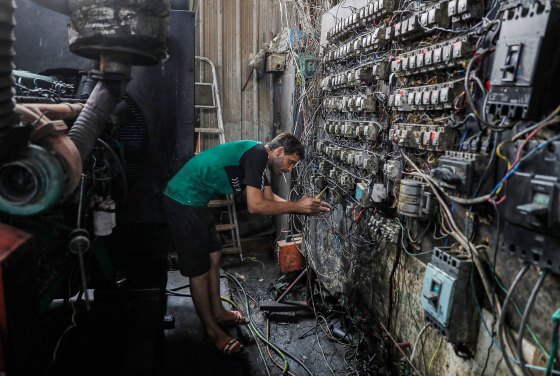
Ahmad Al-Rubaye—Getty Images/AFPA technician controls an electric switch board connecting homes to privately-owned electricity generators in a suburb of Iraq’s capital Baghdad on June 30, 2021 as the national electric grid is experiencing outages amidst a severe heat wave.
Solving the AC dilemma
Gilbert is now in charge of creating a plan to keep the county cool in a safer and more equitable way—she says it will be ready for review by the mayor and the county commission “probably in 10 months.” The heat plan will expand Miami Dade’s weatherization program, a multimillion-dollar fund that helps struggling residents make their homes more energy efficient and more able to withstand weather. It includes money for newer AC systems (which use less energy and contain less environmentally damaging substances than older units), but also home repairs and building improvements which are essential for keeping cool air inside. The plan will also look at strategies to discourage retail spaces from blasting AC while keeping their doors open, Gilbert says.
Another major priority is better educating people about the risks of heat. Advocates say that a lack of awareness about the health risks of extreme heat is a big reason that it’s so deadly. To some extent, it’s a failure of marketing; the Extreme Heat Resilience Alliance—launched in 2020 by the Adrienne Arsht-Rockefeller Foundation Resilience Center—argues that if we named heatwaves in the same way we name tropical storms, it would lead people to take heat seriously. Indeed, the group is launching pilot projects to categorize heatwaves, and assessing methods for naming them, in parts of the U.S. this summer.
In Miami, Gilbert will co-chair a Climate and Heat Health Task Force made up of local health experts, business figures and academics, among others, that will study the health impacts of heat across the county. Based on their work, the city will come up with campaigns to inform residents about the symptoms of heat-related illnesses. They will also reach out to outdoor workers and businesses to make sure they understand both the legal right to a safe workplace and solutions to heat: keeping drinking water available, taking shade breaks, or changing work schedules. Across the city, Gilbert will create “resilience centers” where residents can go to cool off and hydrate during heat waves, particularly when there are power blackouts at the same time.
But Miami also needs better data to address its heat problem. The county currently issues its heat warnings based on temperatures taken at the National Weather Service station at Miami International Airport. But because of the unequal distribution of the urban heat island effect, some parts of town are as much as 10°F warmer than those readings, Cruz says. “That means there are heat advisories that should be happening that aren’t.” In partnership with Florida International University, Catalyst is running a “citizen science project” to install heat and humidity sensors across town, which should soon allow authorities to warn people about heat risks on a more local level.
There will be more visible changes to the urban landscape, too. Miami Dade has a goal of increasing its tree canopy to 30% by 2030 from a little under 20% now, county wide. “It can be 30°F cooler outside under tree cover than in an open pavement area,” Gilbert says. “But trees also sequester carbon, absorb stormwater, and have mental health benefits.” The parks department is leading the charge, prioritizing low-income neighborhoods as well as sidewalks, footpaths and bus stops. (Shading them will be essential to convincing Miamians to walk, cycle and use public transit to reach the city’s emissions goals, Gilbert says). The iconic palm trees that line Miami Beach are slowly being replaced by shade-giving trees. Giveaways of fruit trees by the county’s Department of Environmental Resources Management—given to 200,000 residents so far—allow individuals to begin creating shade in their outside space.
Miami has plenty of ambitious examples to look to as it tries to adapt to the warming of our climate. In July 2020, Arnhem, a town of 150,000 people in the Netherlands, announced a plan to reduce the amount of asphalt and hard surfaces by 10% by 2030—including by ripping up roads on underused four-lane highways—and replace them with grass and trees. The local government is trying to get out ahead of a trend of more people in the town buying AC—far less ubiquitous in most of the E.U. than in the U.S.—after a series of unusually strong heat waves over the last three years, says Cathelijne Bouwkamp, the city alderman. “We are not accustomed to think about heat like this, so we didn’t make our city climate proof and heat proof. Now we need to.”
In India, cities are more used to a hot climate, but with summer temperatures now reaching increasingly dangerous heights, officials are urgently trying to create more comprehensive heat strategies, says Polash Mukherjee, lead on climate resilience at non-profit National Resource Defense Council’s India program. Ahmedabad, a city of 5.6 million in the west of the country, is one clear example: a 2010 heat wave there saw temperatures reaching 116°F, contributing to the deaths of more than 1,300 people. Afterwards, Ahmedabad created a “heat action plan,” a first among India’s large cities. It included policy changes, like programs to send SMS and Whatsapp messages to warn residents about high heat days, to distribute pamphlets on the symptoms of heat stress to reduce the number of hours that construction workers can legally work outside on high heat days; and to force hospitals to move critical care patients to lower floors less exposed to heat. The plan was credited with curbing the city’s loss of life in later heat waves and it has been used as a guideline by more than 100 Indian cities, Mukherjee says. “We’ve really seen a shift over the last two years.”
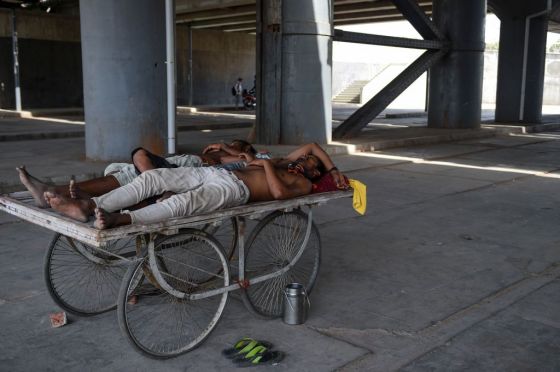
Sam Panthaky—Getty ImagesMen rest on a cart under a bridge near Sabarmati river during a hot day in Ahmedabad, India, on May 28, 2019.
Recognizing the link between equity and climate resilience
Climate experts have long warned that the impacts of climate change—driven by the high-emitting activities of wealthier people and countries—would fall most heavily on poorer people and countries that don’t have the resources to deal with them. In Miami, activists like Gomez and Cruz have fought to convince local authorities to pony up resources to adapt to the climate issues that most affect vulnerable groups. Their efforts finally appear to be paying off. “I think we’re starting to see that shift. I think Jane’s appointment probably starts to mark the change in the tides,” Cruz says. “Pun intended, I guess.”
Farrel, of the Resilient Cities network, says that a similar shift in attitude is taking place in many cities around the world in the wake of the pandemic. The spread of COVID-19 in lower-income neighborhoods, where people couldn’t afford to take time off work to isolate, or where housing was overcrowded or hygiene infrastructure lacking, showed local governments that at times of crisis, their failure to invest in the most vulnerable can put the entire city at risk. “Before, many people understood the idea of resilience, but the pandemic made them feel it,” Farrel says. “Without equity, cities cannot be resilient.”
On a global level, there’s a long way to go to achieve that equity and resilience. Since 2009, rich countries have repeatedly pledged to mobilize $100 billion each year in climate finance—money to help poorer countries adapt to climate change—every year from 2020 onwards. The latest figures on finance suggest wealthy countries are falling anywhere between $21 billion and $81 billion short of that goal, depending on what kinds of finance you count. And crucially, though the pledge was for a 50/50 split between funding to help countries reduce emissions and funding to adapt to climate change, the latter receives just 5% of tracked climate finance, according to research group the Climate Policy Initiative.
Only a handful of rich countries—including Germany, Canada, the U.K., New Zealand and Luxembourg—have announced significant increases to their climate finance pledges this year. “The finances committed so far are vastly inadequate,” says Sonam P. Wangdi, chair of the 46-member group of Least Developed Countries, who leads international climate negotiations on the group’s behalf. The need to scale up support for adaptation will be a major priority for the group at COP26, the U.N. climate conference due to take place in November in Glasgow, Scotland. “Climate change is a global problem just like the pandemic and without that solidarity there, we won’t be able to solve it.”
On a local level at least, Gilbert hopes the heat, which everyone can feel, even if they don’t experience its worst impact, will be an opportunity to build solidarity on climate. ‘We have many conservative-leaning residents as well as progressive, but [few] deny climate change, because it’s a real threat here,” she says. “We need to come into better relationships with our natural world, but also with each other.”
The pseudo-scientific formula that explains most human bonding is basically time + affection + togetherness = relationship. So what happens to humans and their interconnectedness when two of the key elements—time and togetherness—are removed or increased? Can digital communication replace human to human contact? How do couples cope with stressful events they have never before encountered? This is the focus of a series of studies published in the Journal of Social and Personal Relationships, which has dedicated several special issues to relationships in the time of COVID-19.
“When COVID hit it became clear to me that… it would be really important for us to provide a space for relationship science to showcase their work,” says Pamela Lannutti, the director of the Center for Human Sexuality Studies at Widener University in Chester, Penn., and one of the editors of the series of issues. So the journal put out a call for researchers who had begun research on what relationships were like in this unique set of circumstances and the studies flooded in.
[time-brightcove not-tgx=”true”]
Gender roles in the home got more, not less, defined.
A study out of New Zealand found that during the stay-at-home measures, with people working from home and schools closed, each partner in heterosexual relationships had to take on more responsibilities around the house. But women took on many more. While both men and women recognized the situation was imbalanced, it only led to relationship dissatisfaction among the women, unless the men were doing a lot of childcare. That is, the men could see the burden was being unevenly carried, but it didn’t bother them. “There’s definitely a shift back towards traditional gender roles in ways that perhaps weren’t there before COVID,” says Lannutti. “Here’s something that came along and just shook up society in this really unexpected and really quick way. And still those gender roles were so powerful.”
Contrary to expectations, lonely single people didn’t settle.
Using a multinational survey of almost 700 single people, most of them female, a group of researchers from across the globe found that single people were more interested in finding a partner if they were more concerned about COVID-19. The researchers expected single people to lower their standards given the exigent circumstances. They did not. Not even about looks. “They still caredabout physical attractiveness,” says the journal’s co-editor, Jennifer Bevan, a professor of communication at Chapman University in Orange, California, “whichI thought was such an interestingelement.”
People who don’t like video chat just kept meeting in person.
Getting together via video took off during the early days of lockdown, with workplaces and families having to quickly adjust to meeting over Zoom, Google meetings, Bluejeans or other digital platforms. A Utah State university study found that those who had difficulty adjusting to this form of communication were more likely to violate social distancing protocols and pleas to avoid gatherings, in order to see other humans. “The need for connection overrides what’s happening at that moment, which is a scary thought,” says Bevan. “How do we kind of override the need for connection? I know it’s really difficult to do.”
Same sex couples who avoided fighting were less happy than those who voiced their complaints.
In a study of LGBTQ couples, those who refrained from complaining about their relationships when something was wrong had less satisfying relationships, suffered more anxiety and depression, and leaned more heavily on substance use during COVID-19. Their dissatisfaction with their relationships was also worse if they were people of color or had higher internalized homophobia. The researchers noted that one fifth of the participants in the study had decided to move in together because of the pandemic—which paradoxically had made them less anxious while also making the relationship less stable. “We recommend same-sex couples to actively discuss their moving in decisions,” the researchers suggested, “rather than rushing to cohabit without adequate considerations.”
When people can’t meet in person, even fictional characters and celebrities feel like friends.
The lockdown proved to be a bumper time for what researchers call “parasocial relationships,” that is, relationships with folks who don’t know you, but with whom you form an attachment. Because of the isolation and the direct access people had to celebrities via social media as well as via streaming platforms, many people became much more attentive to their favored celebrities. The study found that people maintained stable relationships with friends as the social distancing measures went on, but felt much closer to the celebrities they followed. The editors theorized this closeness might partly be the result of people consuming a lot more content in their homes, through their personal devices. “It‘s not the same as going to anarena and seeing the concert. They’re sitting at their house,” says Bevan, who acknowledged that Taylor Swift helped get her through some hard days. “It makesthat experience a lot different.” These can be famous people, or even fictional characters.
These 5 resilience-building habits seemed to help couples soldier on.
“A problem a lot of couples can face during times of hardship or crisis is relational uncertainty—meaning they aren’t sure how committed they or their partners are or where the relationship is going,” says Helen Lillie, a post-doctoral Fellow at the University of Utah. According to the school of relationship science known as Communication Theory of Resilience, couples who focus on five habits can weather hard times more easily. The five techniques are: maintaining some semblance of normalcy with their routines, talking to their spouse as well as sympathetic others about their concerns, reminding themselves of who they are and what they believe, reframing their situation in a more positive or different way and focusing on how good things will be when the crisis is over. Lillie’s study surveyed 561 people to ascertain whether couples who used those strategies were getting on with their partners better during the pandemic, and found that they did. The study also found humor helped couples cope with the lockdown, although it didn’t always improve couple communication.
Portland food cart co-owners Eric and Nicole Gitenstein didn’t have much choice about whether to open their business during this week’s unprecedented heat wave plaguing the Pacific Northwest. Excess heat from their refrigerators and burners often raises temperatures inside their cart, MF Tasty, 10 to 15 degrees higher than those outside. With area temperatures peaking at 116° F on June 28, working in such conditions could have put their lives in danger.
“It’s better to lose a weekend than to lose your life, or be hospitalized for heat exhaustion,” Eric says.
His fears were warranted—the human toll from the extreme heat that has suffocated the Pacific Northwest in recent days resembles that of an earthquake or hurricane. The high temperatures are responsible for at least 63 deaths across Oregon alone, per officials, while more than 1,100 people across Oregon and Washington states have been hospitalized with overheating symptoms.
[time-brightcove not-tgx=”true”]
The record-breaking temperatures have also exacted a serious economic toll, with businesses across the region—many still recovering from coronavirus shutdowns—closing their doors, many to keep their employees safe. “It just seemed incredibly unsafe to ask anybody to work,” says Cathy Whims, owner of Nostrana, a Portland Italian restaurant. “We couldn’t possibly do that with any good conscience.” At Tough Luck, a bar in Portland, general manager Colin Riley also closed up shop—and was glad he did so. A temperature reading he took in the kitchen early in the afternoon on July 27 registered at 115° F, even with the air conditioning on, in part because of excess heat from the refrigerator. “It was definitely a bit scary,” he says.
Area businesses have been affected by climate disasters before—last September, for example, smoke from massive wildfires caused dozens of Portland restaurants to close. That’s causing some owners and workers to ponder the long-term viability of their operations. “Between the forest fires last year, and the heat wave this summer, it’s definitely making me nervous,” says Tough Luck bartender Spencer Pond. “Will restaurants be able to stay open?”
As the planet continues to warm and the number of too-hot-to-work days add up, business losses across the U.S. are likely to mount. Up to 1.8 billion workforce hours, or about 11 working hours per U.S. worker, could be lost annually over the next three decades due to extreme heat caused by climate change, according to research published this February in the journal Climatic Change. Economic losses caused by those lost hours could rise fourfold between 2016 and 2100.
The issue of extreme heat as a worsening effect of climate change is beginning to make the rounds in Congress. In March, Democrats introduced legislation in both chambers that would direct the Occupational Safety and Health Administration to set new rules meant to protect workers from dangerously hot conditions, like mandating paid cool-down breaks for employees working in high temperatures. Those measures are particularly important for agricultural workers, who often spend long hours working in extreme heat conditions. The legislation appears to have stalled, though the latest heat wave may be shining light on the issue—United Farm Workers, an agricultural union, urged Washington governor Jay Inslee this week to implement emergency standards to protect workers from excessive heat.
If the economic impacts of extreme heat are a threat for the U.S., they may be much worse in parts of the world without the resources and institutions to mitigate the growing problem. “In the long run, rich places as they get hotter will spend money to adapt,” says Bob Kopp, director of the Rutgers Institute of Earth, Ocean & Atmospheric Sciences. “That option isn’t available to people in much of the rest of the world.”
And even the best adaptation efforts may not help the U.S. escape the economic consequences of extreme heat, which could knock $170 billion off the country’s GDP by 2100, according to the U.S. Environmental Protection Agency. For individuals, that means lower paychecks, new medical bills, and lost revenue for many businesses already running on thin margins. Eric Gitenstein, for instance, says the days lost to the heat wave badly hurt Portland’s food carts, which have to make sales during the crucial summer months in order to get through the winter season.
“It’s one thing for this to be a random occurrence,” says Eric Gitenstein, the food cart owner. “If this is the norm, that’s going to destroy our income.”
In the days since the deadly collapse of a condo tower in Surfside, Florida, residents of Miami’s waterfront buildings have found themselves looking up more often. Cracks in garage ceilings, corroded rebar in concrete columns, and signs of saltwater seepage after bad weather—not uncommon features of older seaside structures in this part of the state—are being seen with new and wary eyes. They are being documented on social media, spread rapidly on group chats and shared in unnerved emails to building managers and inspectors.
“Sometimes it takes the exposure from a tragedy for people to really pay attention!” one person commented on an Instagram video posted on Tuesday that’s been viewed more than 620,000 times, which showed a long crack in the ceiling garage of an apartment building in Key Biscayne, an island off the coast of Miami.
[time-brightcove not-tgx=”true”]
The sudden collapse of a 13-story condo tower on June 24 just north of Miami Beach has left at least 18 people dead and more than 140 people still missing as of Thursday. The tragedy has shaken Miami residents who have grown used to natural disasters and regular warnings that they are in the crosshairs of climate change as rising sea levels threaten the city’s coastline. But though it’s not yet clear what factors caused the building to crumble, experts say the fresh sense of panic that the Surfside disaster has set off could have ripple effects that shake years of breakneck growth in Miami real estate, threatening the regional economy which depends on a robust real estate sector.
“I think this just makes the coast a lot less valuable,” says Jesse Keenan, an associate professor at Tulane University who has led research on climate change and financial risk. “That value plays out in the market, it plays out in public finance and it plays out in people’s perception of what it means to move to Florida.”
Ysa Pérez for TIMEA memorial wall, set up on a nearby tennis court fence, full of posters of missing victims on June 30.
For years, experts have warned that real estate in Miami is vulnerable to climate-induced rising sea levels and increasingly stronger storms. For those living on South Florida’s coast, waking up with an ocean view comes with calculated risks. From June to November, homes can be battered by hurricane-force winds that force occupants to evacuate inland. It’s not unusual for people to to wade through knee-deep water to get to their cars after a heavy rain, or watch U.S. Army Corps trucks dumping tens of thousands of pounds of fresh sand to replenish the beaches that serve as a buffer from the rising water. The City of Miami, population 470,000, is home to 26% of all U.S. homes at risk from rising seas, according to real estate site Zillow. According to studies conducted by the Risky Business Project, between $15 and $23 billion of property in the city could be underwater by 2050.
But all of this was supposed to happen gradually. The illusion of time allows for a certain dissonance, with booming real estate continuing to sell the dream of sunny Florida. It remains to be seen what role—if any—climate-related conditions played in the collapse in Surfside, but the event has nonetheless brought to the fore concerns about the ability of the Miami real estate market to sustain its pace of growth as the region grows increasingly vulnerable to the effects of climate change.
“Before, when you hired an inspector to inspect your condo, you would never think that the building could just fall,” says Miami real estate analyst Ana Bozovic. “It just doesn’t happen. That’s crazy.”
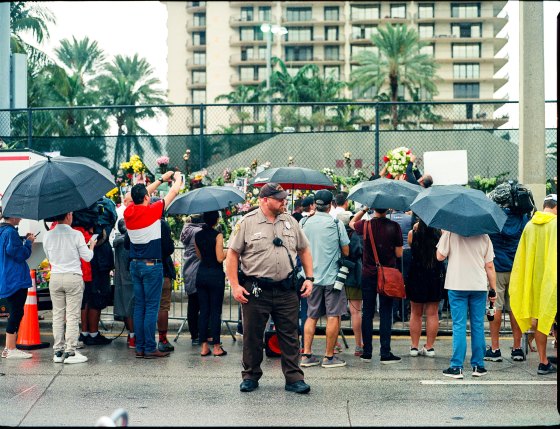
Ysa Pérez for TIMEAn officer stands guard at the memorial wall as people and press take photos of Mayor of Miami-Dade County Daniella Levine Cava and Miami Heat basketball player Udonis Haslem.
The immediate aftershocks of the disaster have played out in a raft of investigations and audits meant to reassure anxious residents. Miami-Dade Mayor Daniella Cava-Levine ordered an immediate review of all buildings in the county that are five stories or taller and constructed more than 40 years ago. (The Surfside building was built in 1981, before Florida’s building codes were strengthened after Hurricane Andrew devastated the area.) The National Institute of Standards and Technology (NIST), a federal agency that investigated the collapse of the World Trade Center on 9/11, has dispatched researchers to the site. The town of Surfside has also hired a leading structural engineer to analyze what caused the collapse and determine if the adjacent buildings are at risk.
But the tragedy has also focused outrage and public attention on the infighting, mismanagement and lack of transparency of some homeowners and condo associations, which in South Florida is worsened by the often astronomical cost estimates for fixes which may defer necessary maintenance. Residents of Champlain Towers South were looking at a $15 million assessment to repair “major structural damage” flagged by engineers, with owners being asked to pay between roughly $80,000 for one-bedroom units to $336,000 for the penthouse.
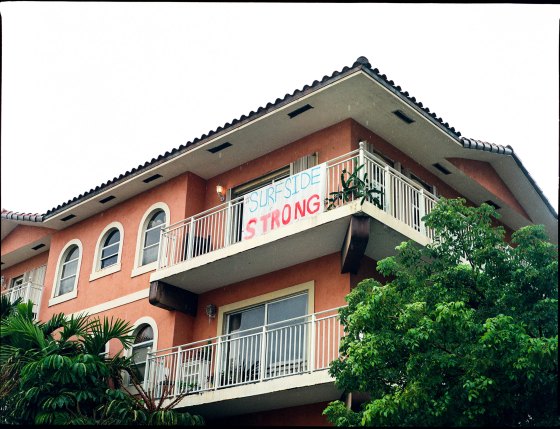
Ysa Pérez for TIMEA sign, that reads “Surfside Strong”, hangs off of the balcony of a nearby apartment building.
Experts say it may take months before clues start to emerge in publicly reported data on what effects the Surfside collapse will have on real estate in the long term. Most immediately, more buyers may be reluctant to buy condos in older buildings located on the ocean’s edge out of concern that a building may have some of the same issues as the one in Surfside, leaving owners to sell at a steep discount or take their property off the market. In the medium term, insurance companies may decide to reprice their policies for oceanside condominiums, raising the cost of living there and likely decreasing their value. In a region where a significant share of the population—and the taxbase—lives in close proximity to the ocean, this could have a ripple effect, drying up public coffers in a state where 30% of local government revenue comes from property taxes.
Speculation about this potential chain of events isn’t anything new. Experts have warned for years that South Florida is particularly vulnerable to a climate-related real estate devaluation. In a January 2020 interview before he joined the Biden Administration, Brian Deese, who now heads the National Economic Council, told TIME that climate risk had not been adequately priced into housing in South Florida and that the region faced the possibility of devaluation as that awareness grows. “Physical risks are not being appropriately priced in,” Deese said. “The degree of capital reallocation and the speed of that is going to be larger and happen more quickly than most market participants expect.” The White House didn’t respond to a request for a comment.
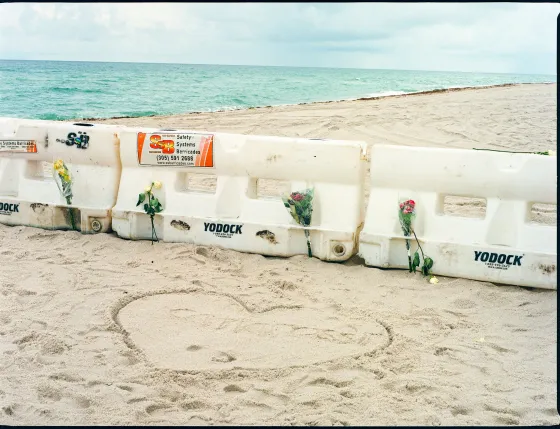
Ysa Pérez for TIMEFlowers attached to barriers on the beach near where the Champlain Towers South collapsed.
For now, concerns of buildings going underwater in the coming decades still seem distant. Condominium associations are reassuring residents that the factors in their own oceanfront buildings “vary drastically” from those of the Surfside building and that they should have “peace of mind,” according to emails seen by TIME. And as far as the market goes, demand in Miami was so high that it can survive a small dip following a one-off event—if that’s what the Surfside disaster proves to be. The pandemic has driven the local market to record highs: from May 2020 to May 2021, sales of existing condos jumped 286%, from 563 to 2,176, according to the Miami Association of Realtors.
But for many who live here, the sudden wake-up call to the tangible and deadly consequences of ignoring costly inspections, maintenance and repairs in oceanfront properties may lead some to realize that their Florida dream is unsustainable. Indeed, Keenan, who is on the faculty of Tulane’s architecture school, estimates that addressing the problems at the collapsed building could have been an even steeper bill that would draw into question the economics of the building altogether.
“The fear is very real,” says Bozovic, the real estate analyst. The older condo buildings dotting the beach may be hard hit in the short term, especially those around the site of the collapse, just north of Miami Beach, where she says buyers won’t want to live in view of the site of the tragedy. “People died there. Who wants to look at that? It’s very sad.”