The list of guidelines to allow students to go to school safely is long and complicated: new classroom designs to protect students, flexible school calendars to prepare for the unpredictable and additional teachers standing by in the event that a large number of them become incapacitated, to name just a few.
This agenda could easily be part of a plan to reopen schools in the middle of the COVID-19 pandemic—but it actually comes from a 2010 report on how Bangladesh can adapt its education system to climate change. Just a few years prior, thousands of schools in the country had flooded; dozens washed away entirely. It wouldn’t be the last time. Today, despite precautions, thousands of schools remain closed in Bangladesh as a third of the country is underwater.
Disruption to education of this scale is largely unfamiliar in the U.S., but COVID-19 has given Americans a hint. The particulars of adapting the U.S. educational system vary from place to place, but, in a sense, the unpredictable challenge offers a dry run for how the country’s educational system will be challenged to adapt to climate change and its various effects.
Disruption
The research into the links between climate change and education is in its early stages, but researchers can already identify a long list of potential disruptions.
The most obvious is the ability of climate-related disasters to force schools to shut down for days, weeks or months. This challenge has already harmed learning across the globe, from developing countries like Mozambique where more than 300,000 children had their education disrupted as a result of Cyclone Idai in 2019 to relatively wealthy locales like California and the surrounding area of Sydney, Australia, where wildfires have kept students out of the classroom for extended periods in recent years. And, because schools serve as a civic center in many communities, they are often turned into disaster response centers when they do survive disaster. That’s good for the people in desperate need of shelter, but it doesn’t do much to fulfill a school’s educational mission.
This problem is only compounded for communities that face repeated extreme weather events that create a pattern of disruption. “The linkages between the disruption of education, and climate change are fairly well established,” says Gautam Narasimhan, senior adviser for climate, energy, and environment at UNICEF. “If there’s repeated disruption to education, that makes a child far less likely to go back to school.”
Temperature acts as a key instigator of climate-related education disruption. On a most basic level, warmer temperatures make it harder for students to focus and excel academically,researchhas shown. This is true in developing countries that lack access to air conditioning and wealthy countries like the U.S. alike. “There’s this comfortable window of temperature that people function well in,” says Heather Randell, a sociologist and demographer at Penn State University who studies climate change and education. “When the temperature exceeds that kids are not doing as well.”Research has also shown that even subtle changes in climate shape educational outcomes. In sub-Saharan Africa and Southeast Asia, two locales prone to drought and extreme temperatures, more rainfall means higher educational attainment. In places prone to storms like the Caribbean, increased rainfall is linked to lower educational achievement, according to research in the journal Proceedings of the National Academy of Sciences.
Beyond the direct threats, climate change poses a much more insidious threat to learning in the developing world. If the family farm floods, for example, a child is much more likely to stay home to help the family earn a living. If a family can’t afford to put food on the table, children will lack proper nutrition and have trouble learning. These problems are worse for girls, who are often the first to be pulled out of school by families in need of extra help. Climate-related migration means consistently disrupting the network of teachers and community where a child learns.
Reopening
It’s hard to apply an educational lesson from the pandemic directly to climate change, in part because the path to reopening schools is so complicated. Facing different on-the-ground coronavirus realities, no two cities are having the exact same conversation.
But it’s clear that climate change may force educators to make similar calculations to those that have come in response to COVID-19. How can classrooms be renovated with resilience in mind? Is it safe to bring kids back to the classroom in the first place, or should they learn remotely? What about students who lack resources at home, whether that’s high-speed internet or air conditioning?
With both challenges, schools will be forced to work their way through these questions. If the COVID-19 pandemic is any hint, the educational system will be woefully unprepared; thinking about these concerns ahead of time can help mitigate that risk.
A version of this article was originally published in TIME’s climate newsletter, One.Five. Click here to sign up to receive these stories early.
It is a frightening time to live in the United States. COVID-19, a novel disease as ruthless as it is seemingly random, is picking us off by the thousands; even many of those who “recover” may never truly be the same again. The pandemic has exposed the gulf between what this country promises for its citizens and what it actually delivers. And as the U.S. barrels toward Election Day, the outbreak is sure to complicate the voting process, with potentially disastrous results.
For a short time in the spring, it appeared the U.S. was getting a grip on its outbreak. Hard-hit states like New York successfully flattened the curve, thanks largely to a statewide shutdown of nonessential businesses and compliance with new rules requiring people to wear masks and practice social distancing. But as other states began to reopen in late spring and early summer, new hot spots developed, first in the Sun Belt, in states like Texas, Arizona and Florida, and more recently in the Midwest, in states like Indiana, Illinois and Minnesota. On the West Coast, California reported a new single-day high for confirmed cases on Aug. 10; on the East Coast, Virginia did the same on Aug. 7. Across the country, hospitalization rates have gotten frighteningly high, and more deaths seem bound to follow.
The U.S. is surely losing the war on COVID-19, but it did not have to be this way. Of the G-7 countries—the U.S., the U.K., Canada, France, Japan, Germany and Italy—only we have an outbreak that continues to spin out of control. Some other nations, like New Zealand, have even come close to eradicating COVID-19 entirely (a somewhat easier feat in a less populated and more isolated country, to be sure). Depressingly, in the months before the pandemic, the U.S. was considered to be among the countries best prepared to handle a major outbreak.
At this point, we can start to see more clearly why the nation has foundered so miserably. A failure of political leadership at all levels; a distrust of scientists, the media and expertise in general; and deeply ingrained cultural attitudes about individuality and the values placed on life have all combined to result in a horrifically inadequate pandemic response compared to what are traditionally considered the U.S.’s peer nations.
That the U.S. federal government has failed in its duty to protect Americans’ health and well-being in a time of crisis is, by now, abundantly obvious. Despite the best attempts of public-health officials and others, many elected officials in the U.S. did not take the threat of COVID-19 seriously from the jump. By the time it became clear that the virus posed a major threat, federal efforts were confused at best. The government’s disarray was best demonstrated by an April episode in which Jared Kushner, senior adviser to his father-in-law, President Donald Trump, and at the time tasked with orchestrating the federal response to the virus, confusingly claimed that a federal stockpile of ventilators—crucial equipment for saving severely ill patients—was not meant for the states.
“The notion of the federal stockpile was, it’s supposed to be our stockpile—it’s not supposed to be state stockpiles that they then use,” he said, leaving unclear who, exactly, those ventilators were for if not for Americans, the vast majority of whom live in one state or another.
In some instances, the federal response exceeded inadequacy and became downright harmful. Desperate for supplies as the pandemic worsened in early April, some hospital executives, doctors and other caregivers turned to shady dealers to arrange for shipments of overpriced gear from China. At the height of the outbreak, the federal government was intercepting some of those shipments, for reasons that remain unclear. Dr. Andrew W. Artenstein, chief physician executive at non-for-profit health care network Baystate Health in Springfield, Mass., even claimed he had to go so far as to ship personal protective equipment in trucks “cleverly marked as food-service vehicles” to evade possible federal seizure. The story would make for a pretty good Smokey and the Bandit reboot if it wasn’t so maddening.
A complete catalog of Trump’s failures to adequately address the pandemic is the stuff of books, not single articles. But a quick summary: he wasted weeks early on downplaying the virus; he has stubbornly clung to a fantastical belief that the virus will simply “disappear”; he banned many travelers from China but squandered the time the move bought him by failing to set up an adequate testing and tracing program; he encouraged states to reopen ahead of his own Administration’s guidelines; and he has repeatedly cherry-picked statistics that make the situation in the U.S. look far better than it is in reality, most recently in a disastrous interview with Axios on HBO released Aug. 3, in which he mischaracterized the U.S. death rate from the virus. Then there were the masks.
Experts say that one of Trump’s most significant missteps was his refusal until recently to be seen in public wearing a face covering. It’s established science that wearing a facial covering significantly reduces the spread of COVID-19, and a pre-existing culture of mask-wearing in East Asia is often cited as a central reason that many places in that region were able to quickly control their outbreaks. But in a country without such an existing norm, it’s incumbent upon leaders—political and otherwise—to model that behavior.
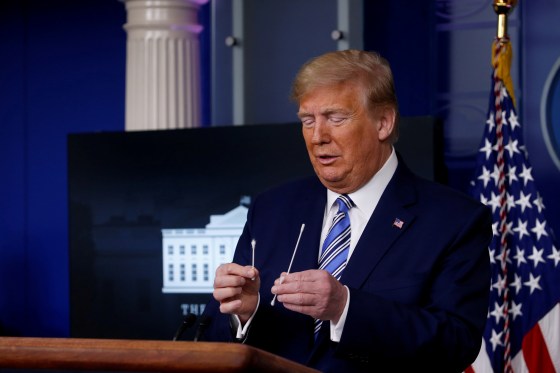
Al Drago–REUTERSPresident Donald Trump compares a swab for coronavirus disease testing with regular cotton swabs during the daily coronavirus task force briefing at the White House, on Apr. 19, 2020.
When Trump appeared in the White House briefing room on April 3 to announce recommendations from the U.S. Centers for Disease Control and Prevention (CDC) that every American should wear a cloth face covering, he undercut the advice of his Administration’s own experts by emphasizing that mask-wearing would still be “voluntary” and that he personally wouldn’t be doing it. Trump, a man long obsessed with self-image, continued to mostly reject masks until a visit to Walter Reed National Military Medical Center on July 11, at which point more than 130,000 Americans had already died of COVID-19. Trump has since softened on mask-wearing somewhat, following pressure from allies like South Carolina Senator Lindsey Graham and Fox & Friends co-host Steve Doocy.
“I view it this way: anything that potentially can help, and [masks] certainly can potentially help, is a good thing,” the President said during a July 21 coronavirus briefing. “I have no problem. I carry it. I wear it. You saw me wearing it a number of times, and I’ll continue.”
But Trump’s early defiance set the tone for his party and his followers, no doubt contributing to the depressingly predictable politicization of mask-wearing. A Pew Research Center survey published on June 25—two weeks before the huge resurgence of the virus in early July—found that 63% of Democrats and Democratic-leaning independents said masks should always be worn, compared to only 29% of Republicans and Republican-leaning independents. Nearly a quarter of Republicans (23%) said masks should “never or rarely be worn.” As the virus rages on and more people view it as an imminent threat, attitudes are changing: 58% of Republicans now say they favor wearing a mask in public, according to a July 23 poll from the Associated Press and the NORC Center for Public Affairs Research—but that’s still far below the 89% of Democrats who say so. Meanwhile, stories of violent encounters between mask skeptics and mask wearers continue to make headlines nearly every week.
Masks aside, the most glaring failure of the federal government has been, and continues to be, a lack of adequate testing infrastructure, which is a key element of pandemic response, as testing shows how bad an outbreak is getting and reveals key hot spots. Testing shortages and delays were a major problem early in the U.S. outbreak before capabilities were ramped up, and are once again plaguing the country as the virus spreads across multiple states. Some Americans say they are waiting more than two weeks for their test results, which researchers say become effectively useless after only two days (the longer people go between getting tested and receiving their results, the bigger the window of opportunity for them to get infected in the interim). The delays—which are being caused by a mixture of labs’ inability to get the necessary supplies to run tests, a lack of cooperation between rival labs, and inadequate federal guidance—have gotten so bad that demand for tests across the U.S. has actually decreased even as the virus continues to spread, a sign that Americans are simply too fed up with waiting for their results to even bother getting tested in the first place.
Kristin Murphy/The Deseret News–APVehicles line up for testing outside of the Monument Valley Health Center in Oljato-Monument Valley, Utah, on Apr. 17, 2020.
Rather than call for more testing capacity, Trump has instead suggested that maybe the U.S. should be testing less. He has repeatedly, and incorrectly, blamed the recent increase in cases in the U.S. entirely on increased testing. While the U.S. is indeed running more tests than any other country, the percentage of those tests coming back positive increased from about 4.5% in mid-June to nearly 8% by Aug. 12, according to the COVID Tracking Project, suggesting the virus is spreading whether we test for it or not. (By comparison, Germany’s daily positivity rate is under 3%, in Italy it’s about 2%, and in New Zealand it’s under 0.5%.)
Improved testing capacity has been a problem for the President, because it has revealed the alarming depth of the U.S. outbreak. For Trump, the U.S. caseload isn’t a matter of public health, it’s more like a golf score: the higher it goes, the worse he’s doing, and he only has so much time left to reverse things before the 18th hole: this November’s election. But rather than address the root cause of the expanding outbreak, he’s simply blaming his embarrassing results on the scorekeeping. “If we didn’t do testing, we’d have no cases,” the President said during a Fox News event in June. “When you do tests, you have cases.” In reality, knowing the true scope of the outbreak can help public-health officials, lawmakers and so on make better, smarter choices—so long as they know the actual score.
Take a quick scroll through your Facebook feed. If you’re like many Americans, there’s a good chance you’ll see, mixed in with photos of babies and vacations, posts that (falsely) claim COVID-19 is a Bill Gates–led global conspiracy or (falsely) claim that mixing ginseng, orange juice and cooking oil is the secret cure or (falsely) claim that the entire pandemic is a hoax. (Facebook and other social-media companies are at least trying to fight outbreak disinformation, but that’s a Sisyphean task if there ever was one.) Despite the corrosive effect of social media, Americans overall tend to have more trust in science than those in many other countries, according to a 2018 study from the Wellcome Trust. Our faith in scientific leaders has remained steady over the last several decades, with around 40% of Americans saying they have a “great deal of confidence” in the scientific community every year since 1973, according to the NORC Center. Furthermore, before the pandemic, the share of Americans who had at least “a fair amount” of confidence that scientists work in the public interest was as high as 86% in 2019, according to Pew.
However, digging deeper reveals a disturbing partisan trend that’s now playing out in important ways: while 43% of Democrats still told Pew in 2019 that they had a “great deal” of trust in scientists, only 27% of Republicans said the same. Moreover, Democrats were also more likely (73%) than Republicans (43%) to believe scientists should take an “active role in policy debates”—results that foreshadow the American right wing’s ongoing efforts to minimize public-health officials and other experts. In a survey published in June, researchers at Johns Hopkins University (JHU) found that while 89% of Democrats viewed social distancing to be “very important,” the same was true of just 66% of Republicans. The JHU researchers also found that a person’s faith in science tends to predict whether they will follow public-health guidelines: while 80% of Republicans who trust science said social distancing was important, only 55% of Republicans who doubt science said the same.
The President and other national leaders and commentators on the right have routinely disparaged public-health officials throughout the crisis, often criticizing their calls for shutting down businesses and other drastic but necessary measures. Trump has also amplified messages that undermine the legitimacy of America’s public-health institutions. “The most outrageous lies are the ones about COVID-19,” tweeted Chuck Woolery, a former game-show host turned political commentator, on July 12. “Everyone is lying. The CDC, media, Democrats, our doctors, not all but most that we are told to trust.” A day later, Trump retweeted Woolery’s message to his 83 million followers.
No single person better represents the bitter politicization of science than Dr. Anthony Fauci, longtime head of the National Institute of Allergy and Infectious Diseases. Fauci, whose job during the pandemic is primarily to coordinate vaccine development and communicate with a frightened public, has been the foremost U.S. scientist on COVID-19. He’s also a straight shooter whose candid admissions about the country’s failings to handle the outbreak has put him at odds with most others in the Trump Administration, leading to a very public falling-out with the President. While Fauci’s responses to Trump’s criticisms have been mild and measured—”I have not been misleading the American public under any circumstances,” he said on ABC’s Good Morning America on July 28 after Trump retweeted messages suggesting otherwise—Trump’s attacks have centered Fauci in the public debate. He is now in many ways this crisis’s Robert Mueller, an old-school civil servant whom Trump’s supporters see as an enemy but his detractors view as a hero. The reality, however, is that Fauci—like Mueller—is just a guy trying to do his job as best he can despite the heavily politicized circumstances.
Some lost faith in science is at least understandable given that public-health organizations’ COVID-19 recommendations are continually changing. That’s rooted in the reality that scientific understanding of the newly emergent virus is evolving in real time—science is slow; the virus is fast. But the ever-shifting advice can make it seem like public-health officials don’t know what they’re doing. When groups like the World Health Organization are late to recommend that people wear cloth face coverings and to accept that SARS-CoV-2, the virus that causes COIVD-19, is likely airborne, it doesn’t instill public confidence, especially in those already primed to be skeptical of experts.
“It’s genuinely a confusing information environment that we’re in right now,” says Dr. Colleen Barry, chair of the department of health policy and management at Johns Hopkins Bloomberg School of Public Health. “In an issue that’s life or death, people want to know what they should do and what they shouldn’t do. Because this is a new infectious disease, a new virus, we don’t have all the answers scientifically. Sometimes we have little pieces of information, but they don’t fit together in a broader answer to specific questions. I think that creates an environment that could potentially erode trust even further over time.”
Truly worrying are the numbers of Americans who already say they are hesitant to receive a COVID-19 vaccination if and when one becomes available. Given recent research suggesting that “natural” herd immunity to this virus is all but impossible to achieve, a vaccine is our only way back to anything resembling normal life—but mass vaccination will only work with enough buy-in from a trusting public. The damage that the President and others are doing to Americans’ trust in science and professional expertise could have significant consequences on the country’s ability to get past this pandemic, even if Trump does not win a second term this November.
It’s no secret that Americans tend to be more individualistic than people in many other nations. A 2011 Pew survey found that 58% of Americans said that “freedom to pursue life’s goals without interference from the state” is more important than the state guaranteeing “nobody is in need,” compared to just 38% of Britons, 36% of Germans and the French, and 30% of Spaniards. It’s easy to view that trait as a root cause of the country’s struggles with COVID-19. After all, a pandemic requires individuals to make temporary sacrifices for the collective good, whether it’s wearing a mask they find uncomfortable or canceling a planned birthday party.
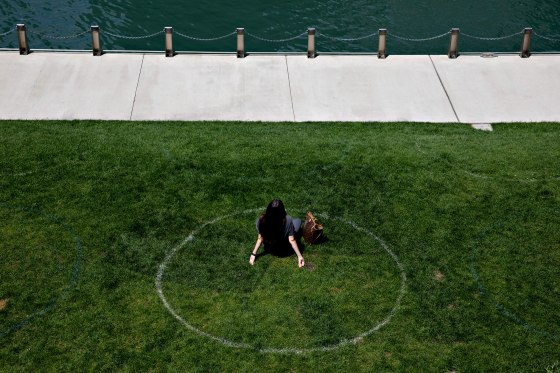
Daniel Acker/The New York Times–ReduxA woman sits in a social distance circle along the Chicago River in Chicago, on Aug. 4, 2020.
But in reality, Americans have shown time and again that they’re willing to work together to achieve a common goal, especially in times of crisis. Most of the country’s greatest achievements, from independence to defeating the scourge of 20th century Nazism to putting humans on the moon, were largely collective efforts. “We do come together on many, many things when we have good leadership,” says Dr. David Rosner, a professor at Columbia University who specializes in the history of public health.
In terms of COVID-19, perhaps more instructive than Americans’ general views on individualism are our specific beliefs regarding sickness itself. Americans have had mixed views on disease since the colonial era, Rosner says, with some viewing it as a public issue requiring collective action and others as a matter that should be left to those who get sick. The words and deeds of the country’s leaders can push the national sentiment in either of those directions, argues Rosner, and Trump has clearly opted for the latter.
“We take our cues from leaders,” Rosner says, “and if they seem to suggest that ‘I, being a moral person, will not get a disease and will not be sick and I can go around and not wear my mask, because, after all, it’s only the weak and the vulnerable and the stupid and the immigrant’—[that] it’s only the ‘other’ that really is vulnerable, well, then, Americans will start to believe that, too.”
There’s another disturbing undercurrent to Americans’ attitude toward the pandemic thus far: a willingness to accept mass death as an unavoidable part of everyday life. We, as a nation, have become dull to tragedy as a result of near-daily exposure to unspeakable horrors, from wanton gun violence to the seemingly never-ending incidents of police brutality to the ongoing clean water crisis in Flint, Mich., and elsewhere. “In retrospect Sandy Hook marked the end of the U.S. gun-control debate,” columnist Dan Hodges memorably remarked nearly three years after the 2012 tragedy in which a gunman shot and killed 26 people at a Connecticut elementary school; Congress failed to pass any new gun laws in the wake of the horrific incident. “Once America decided killing children was bearable, it was over,” Hodges wrote.
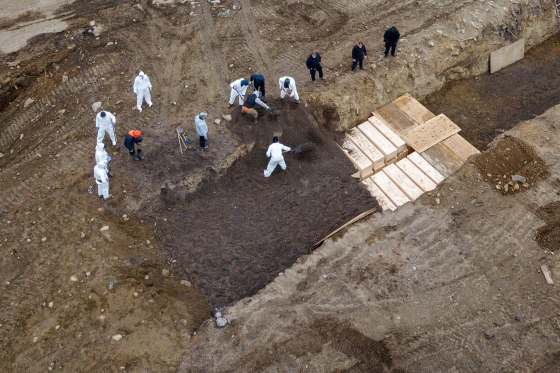
Lucas Jackson–APBodies are buried on New York’s Hart Island amid the coronavirus outbreak in New York City, on Apr. 9, 2020.
It is difficult to quantify apathy. But what, besides a torpid acceptance that thousands more Americans will inevitably die of COVID-19, can explain that a quarter of Americans—roughly 82 million people—still don’t believe masks should always be worn in public places? What else can explain that Disney World partially reopened to guests on July 11, a day before its home state of Florida reported more than 15,000 new daily cases—setting what was then a record for all U.S. states—and people showed up en masse? What else can explain that, while air travel is down significantly, hundreds of thousands of people—mostly vacationers—are still boarding airplanes every day, potentially spreading the virus as they move about the country, whether they know it or not?
There are reasons to be optimistic about the future of the pandemic in the U.S. So far, America’s new hot spots have not seen the catastrophic mortality rate that befell states like New York and New Jersey. Most likely that’s because deaths are a lagging indicator, but it could also be because physicians have gotten better at treating the virus. That California’s governor announced a major rollback of his reopening plan in mid-July amid a worrying new spike in cases shows that at least some leaders are rethinking their strategies to match reality. Multiple efforts to create a vaccine continue apace; it’s possible at least one will be available by the end of the year, though that’s probably a generous estimate. And there’s a chance that, as the virus rages on, more Americans will get on board with public-health measures.
“There’s a learning curve for the public around what’s really happening, that in my estimation, at least over the long term, [offers] a potential for convergence,” says Dr. Ann Keller, an associate professor at the UC Berkeley School of Public Health who specializes in health politics and policy. “That Americans will start to say, ‘If everyone’s not wearing masks, if everyone’s not social distancing, if people are having family parties inside with lots of people together, if we’re flouting the public-health recommendations, we’re going to keep seeing transmission.’”
Regardless, the pandemic seems likely to leave the U.S. weakened and adrift for at least the near term, with hundreds of thousands, possibly even millions, of its citizens dead. It has already exposed significant foundational flaws, from a disastrously frayed social safety net to life-threatening systemic racism. It has made clear that many of us do not think of ourselves as our brothers’ keepers, perhaps forever damaging any sense of community among neighbors. And it has crippled our standing on the world stage—who would want to import American ideals when those ideals bring death on a mass scale? Many Americans will not survive this pandemic. Those who do will be left with considerable work to fix ourselves—and our country.
There are a lot of ways to try to capture grim milestone the world crossed Monday night when it recorded its 20 millionth case of COVID-19. It’s two Swedens, four Irelands, 10 Slovenias. It’s greater than the entire population of the state of New York. The outbreak that began in Wuhan, China in December 2019 has now spread to 188 countries and regions, touching every continent but Antarctica.
The U.S. continues to lead the world in total cases, having crossed its own milestone—to 5 million—on August 9. Brazil comes next, with 3 million; followed by India at 2.2 million; Russia at 890,000; and South Africa, at 560,000. Global death tolls have now surpassed 732,000, led again by the U.S., at over 163,000.
Among the top 20 countries—a list which also includes Mexico, Peru, Spain, the United Kingdom and Pakistan—there are some small but encouraging signs. Five-day moving averages are trending down in 11 of those hard-hit spots, with the U.S. among those showing some faint improvement. But the remaining nine have all seen cases rise over the same period.
As with all pandemics, the increase in caseload has not remotely been linear, and instead is accelerating rapidly. It took from December until April 2 before one million cases were recorded worldwide. The number then took less than seven weeks to quintuple to 5 million cases, on May 20. The 10 million milestone was reached just over five weeks later, on June 28. On August 6, the world hit 19 million cases—and now it’s 20 million. Looked at another way, it took nearly four months for first million people to be diagnosed, but just 4 days to record the most recent million.
Slowing that trend depends on all of those 188 countries and regions doing their part to control their infection rate, but the majority of the responsibility lies with the big five countries to flatten their domestic curves. Within the U.S., the burden falls especially on the big three states—Texas, California and Florida, which together represent more than 40% of new domestic cases over the past 14 days—to put their coronavirus genie back in the bottle. At the current global rate, the 21 million mark will be reached before the weekend.
Much of Canada’s remaining intact ice shelf has broken apart into hulking iceberg islands thanks to a hot summer and global warming, scientists said.
Canada’s 4,000-year-old Milne Ice Shelf on the northwestern edge of Ellesmere Island had been the country’s last intact ice shelf until the end of July when ice analyst Adrienne White of the Canadian Ice Service noticed that satellite photos showed that about 43% of it had broken off. She said it happened around July 30 or 31.
Two giant icebergs formed along with lots of smaller ones, and they have already started drifting away, White said. The biggest is nearly the size of Manhattan — 21 square miles (55 square kilometers) and 7 miles long (11.5 kilometers). They are 230 to 260 feet (70 to 80 meters) thick.
“This is a huge, huge block of ice,” White said. “If one of these is moving toward an oil rig, there’s nothing you can really do aside from move your oil rig.”
The 72-square mile (187 square kilometer) undulating white ice shelf of ridges and troughs dotted with blue meltwater had been larger than the District of Columbia but now is down to 41 square miles (106 square kilometers).
Temperatures from May to early August in the region have been 9 degrees (5 degrees Celsius) warmer than the 1980 to 2010 average, University of Ottawa glaciology professor Luke Copland said. This is on top of an Arctic that already had been warming much faster than the rest of globe, with this region warming even faster.
“Without a doubt, it’s climate change,” Copland said, noting the ice shelf is melting from both hotter air above and warmer water below. “The Milne was very special,” he added. “It’s an amazingly pretty location.”
Ice shelves are hundreds to thousands of years old, thicker than long-term sea ice, but not as big and old as glaciers, Copland said.
Canada used to have a large continuous ice shelf across the northern coast of Ellesmere Island in the Canadian territory of Nunavut, but it has been breaking apart over the last decades because of man-made global warming, White said. By 2005 it was down to six remaining ice shelves but “the Milne was really the last complete ice shelf,” she said.
“There aren’t very many ice shelves around the Arctic anymore,” Copland said. “It seems we’ve lost pretty much all of them from northern Greenland and the Russian Arctic. There may be a few in a few protected fjords.”
In recent decades, tens of thousands of people around the globe have died as the result of extreme heat, and yet the phenomenon of deadly heat would be easy to miss. That may not be true much longer.
A new analysis published this week by the National Bureau of Economic Research suggests that, if left unchecked, climate change could drive temperatures up to the point where they would lead to 85 deaths per 100,000 people globally per year by the end of the century. That’s more than are currently killed by all infectious diseases across the globe.
“We’re doing a lot of things around the world that are improving healthcare rapidly,” says Solomon Hsiang, a professor of public policy at the University of California, Berkeley, and one of the authors of the new paper. “Climate change would be a giant step backwards on that progress.”
The paper is formally a “working paper” and has not undergone peer review, but it quantifies a reality that researchers who study climate change have long understood. Humans already struggle to survive in extreme temperatures, and that challenge will only get worse as average global temperatures rise. Even today, many people—particularly older adults—are vulnerable. A 2015 heat wave in India and Pakistan, for example, killed more than 3,000 people.
The new research suggests temperature rise will become an increasingly significant strain on the health care system, forcing doctors to battle a surge in heat-related ailments over the coming decades.
Some places will handle those challenges better than others. Already, vulnerability to extreme heat isn’t equally distributed, with poor communities and poor countries more vulnerable to heat-related ailments than their wealthier counterparts. The new study shows how that inequality will continue with time: some of the worst-off places today could reach a death rate as high as 160 per 100,000 people. On the other extreme, countries that can afford to adapt and currently occupy cold climates—which, according to the study, are primarily northern European—are actually likely to see lower annual death rates thanks to warmer temperatures. Other wealthy countries will still face a spike in mortality, but their economic resources will help cushion the impact. “A lot of the pain for wealthy populations is going to be through their pocketbooks,” says Hsiang. “In poorer, hotter locations, people will die.”
The study has important technical and policy implications. For years, economists and policymakers have tried to determine a “social cost of carbon” that quantifies the economic value of preventing a ton of carbon dioxide emissions. The Obama administration calculated it at around $50; the Trump administration has put forth estimates suggesting it’s as low as $1.
This new study finds that the social cost of carbon is $37—for heat-related mortality alone. But that’s just the tip of the iceberg. When you consider the cost of hurricanes, floods and climate migration, as well as a slew of other challenges, the study suggests that the social cost of carbon is likely to be much higher and, therefore, the urgency to act much greater. These findings all underscore a familiar conclusion: acting now to address climate change will saves lives and dollars in the long run.
The scariest dream my now-college-age daughter ever had was the one about the running legs—or, as they became known in our family, The Running Legs, almost audibly capitalized. She was in kindergarten at the time and the dream amounted to little more than an image of a pair of black tights, filled by an invisible lower body chasing her.
It was the first thing she mentioned when she got up in the morning and she brought it up again over breakfast—clearly distressed. We talked about it a bit and I asked her what she thought the legs would have done if they had caught her.
“Bite me,” she answered.
“With what?” I asked.
That made her laugh, but not so much that she didn’t also mention the dream to her teacher, who had her draw a picture of it and then talk through it together. The fear faded after that, but the memory did not.
Silly or not, childish or not, The Running Legs checked several boxes that would generally qualify it as a nightmare. It was recalled upon awakening—and may even have been the reason for the awakening. It caused distress the next day. It involved danger—in the case of nightmares, it’s most commonly some kind of physical aggression, a serious accident, a disease, or, yes, being chased.
Nightmares may also involve being the person who causes harm to other people. “Humans are social beings,” says professor Michael Schredl, a sleep researcher at the Central Institute of Mental Health in Mannheim, Germany, and nightmares may be sign that a bit of the social code that keeps us in line during the day and is fundamental enough to who we are that it apparently operates even in our sleep. From the time we emerged as a species we have depended on our acceptance within a group for our very survival, and violating the rules of that group could mean banishment. “I think those nightmares point to that importance,” Schredl says.
It would be nicer for all of us if nightmares didn’t exist in the first place, but it’s hardly surprising that they do. If the sleeping brain is forever screening the sometimes absurdist movies that are our dreams, it’s no surprise that now and then it would choose a horror film. But there are open questions: why you have one on one night and not another; why some people suffer from them more than others; what the specific content of the bad dreams signifies.
Researchers have long worked to answer those questions and in recent years have succeeded in unraveling at least some of the mysteries. What’s more, they are developing new, often high-tech ways to observe the sleeping brain as nightmares play out and even read some specific elements of the storyline or at least the imagery. There may even be a way to step in and change the nightmare narrative—stimulating the brain to allow the dreamer to take control of the experience, all the while remaining asleep.
Nightmares do not strike us all equally. According to a 2017 study of U.K participants published in Social Psychology and Psychiatric Epidemiology, about 5% of the overall population experiences a nightmare at least once a week, which is sufficiently frequent to qualify as a diagnosable disorder. A larger share of the population—30% to 55%—has an average of one nightmare a month, according to a Hong Kong-based study published in the journal Sleep. And the American Society of Sleep Medicine reports that around 85% of us report at least the occasional nightmare, a finding confirmed by multiple studies.
Where Nightmares Come From
The seeds of future nightmares may be planted early in life, during what’s known as the “infantile amnesia” period, which lasts from birth to about age three and a half, and is a time of life during which virtually no enduring memories are formed. Infantile amnesia gets disrupted, however, if the child experiences significant trauma during that sensitive time-window—physical abuse, witnessing domestic violence, or being placed in rotating foster care with no consistent attachment figures, to name a few examples. This can lead to what psychologist Tore Nielsen, of the University of Montreal, dubbed the Stress Acceleration Hypothesis (SAH), in a 2017 paper published in Frontiers of Neurology. The idea behind SAH is that early adversity of these sorts can accelerate the development of skills that govern fear and crisis management—which are useful for the child, but come at a long-term cost.
“The trauma leads to brain changes that help the child adapt short-term,” says psychologist and dream researcher Louis-Philippe Marquis of the University of Montreal, who had Nielsen as a thesis adviser. “But they may facilitate nightmares and psychopathology later in life.”
According to the SAH hypothesis, the originating trauma doesn’t have to be out of the ordinary; merely the birth of a sibling in the infantile amnesia window can make someone more prone to nightmares. And no wonder: the first child goes from being the sole focus of parental attention to having to share that love—and the new arrival usually gets the majority of the care, simply because infants are so demanding. In his 2017 paper, Neilsen wrote that firstborn children had frightening dreams more than twice as frequently as last-born children, regardless of potential confounders like age, sex, and number of siblings.
Other, less traumatic factors can contribute to nightmares too. In a 2018 study of 1,216 subjects, Schredl found that simple daily stress is a powerful causative factor. “All kinds of stress increase nightmare frequency,” Schredl says. “There don’t need to be any unrecognized issues in the subconscious.”
Individual temperament may also be a factor in the occurrence of nightmares. Schredly has found that people who score higher on tests of empathy and sensitivity are more likely to pay for daytime stress with a sleep-time nightmare. Research by Bryrony Sheaves, a clinical psychologist at the University of Oxford specializing in, among other things, sleep disturbances, has connected nightmares to a painful triptych of temperamental tendencies: paranoia, frequent depersonalization, and hallucinations. Sheaves stresses that in all of these cases she is not describing clinical conditions: some people are more suspicious than others; some tend to feel depersonalized in moments of social stress like walking into a party filled with strangers or delivering a speech; in the case of hallucinations, Sheaves is describing mostly people who experience vivid dreamlike imagery while falling asleep or waking up—the so-called hypnagogic or hypnopompic states. In all of these people, nightmares are likelier to occur more frequently.
“In reality, there is not one single cause for nightmares for most people,” says Sheaves. “The exception for that is if they’re part of a wider PTSD issue.” Among people with PTSD, or post-traumatic stress disorder—especially combat veterans and victims of sexual assault or other violence—anywhere from 71% to 96% report frequent nightmares, according to the U.S. Department of Veterans Affairs. Indeed, nightmares are one of the defining symptoms of the condition.
Just which parts of the brain serve as the projection booth for nightmares is uncertain. Marquis explains that the likeliest loci are the anterior cingulate cortex, hippocampus, amygdala, and medial prefrontal cortex. The anterior cingulate cortex plays a role in emotion, blood pressure, heart rate, morality and where we allocate our attention, all of which come into play during nightmares. The principal role of the hippocampus is to regulate and process memory—which helps vivid or traumatic experiences lived during the day or deeper in the past get replayed in dreams, especially in PTSD patients.
But the two biggest players in the cranial gang of four are the amygdala and the prefrontal cortex. The amygdala is in what amounts to the basement of the brain, both physically (it is deeply buried, not far from the brain stem) and functionally (it’s where the demons are kept, especially fear, aggression, anger and sadness). When we’re awake, the prefrontal cortex keeps a close watch on what all those emotions are up to downstairs. But, “during sleep, the frontal areas of the brain are shut down and the brake that actively suppressed the emotions in the amygdala during the day does not work properly anymore,” says Stephanie Rek, a PhD student and clinical trainee studying sleep at Ludwig Maximilian University in Munich. When the brain signs off for the night, the monsters come out to play.
Learning to Read the Contents of Dreams—and Nightmares
As awful as nightmares can be, they aren’t necessarily always a bad thing. New research into the brain regions involved in nightmares has found that in some cases a dream-time scare may even have some adaptive value.
In a 2019 study published in the open access journal Human Brain Mapping, a team led by Virginie Sterpenich, senior researcher at the University of Geneva’s Swiss Center for Affective Sciences, recruited 89 subjects and had them keep a dream diary for one week, in which they reported the contents of their dreams and the associated emotions, including fear, anger, sadness and disgust. Later, those subjects underwent functional magnetic resonance imaging (fMRI) while looking at pictures of faces with what the researchers had determined were happy, funny, or menacing or frightening expressions. When looking at the frightening or menacing faces, subjects who reported fewer nightmares in their dream diary, showed fMRI activity in the insular and midcingulate cortices of the brain, which more or less mirrored that of people having bad dreams. In subjects who reported more nightmares, those brain regions were less reactive to the negative images—effectively shrugging them off. The implication, according to Sterpenich and her colleagues: bad dreams experienced in the safety of the bed can actually serve to help us better handle genuinely frightening or threatening episodes in the real world.
More experimental—and more tantalizing—is research being led by Tomoyasu Horikawa and Guohua Shen, both of the Advanced Telecommunications Research Institute International in Kyoto, Japan, which may make it possible to use fMRI scans to actually peek at the visual content of subjects’ dreams. The premise, which they explored in depth in a 2019 paper in PLOS Computational Biology, first involves machine-learning—teaching a deep neural network to recognize an encyclopedic collection of images including animals, airplanes, faces, trees, mailboxes, cars and on and on. The researchers then used an fMRI to read the visual cortex of human subjects as they looked at or were instructed to imagine the same objects. Subjects were also allowed to fall asleep in an fMRI machine, then were awakened during the hypnagogic state and asked what images they had been seeing in their half-dreams. The fMRI data from those mind-pictures were when coded to their responses.
Then, the resulting database was put to the test: Subjects were placed back in the fMRI while looking at or imagining particular images and their brain readings were then fed into the deep neural network which would try to understand and recreate the images. It was startlingly accurate.
The face of a tiger or the picture of a tree that the machine spit out in response to the brain reading might be fuzzy or sloppy or need to be turned this way or that before it became clear just what it was, but all the same, the machine read many of the subjects’ brains and even in a rough way, saw what it was seeing. It’s too early to say what practical effect such a mind-reading system could have, but with the assistance of a therapist, it could be used to help those with regular nightmares work through the content of the dreams, as well as to habituate and desensitize them to the imagery.
Learning How to Control Nightmares
Another type of new technology might have an even more direct effect on mitigating nightmares. Known as transcranial stimulation, it involves introducing low levels of low-frequency energy into the frontal and temporal lobes of the brain. That has been experimentally shown to change ordinary dreaming into what’s known as lucid dreaming, most convincingly in a 2014 study published in Nature Neuroscience and led by Ursula Voss, a psychology professor at J.W. Goethe-University in Frankfurt Germany. In the lucid dream, the sleeping brain is aware that the experience is just a dream, can stand back from it and observe it like a third person and, in some cases, can take control of the narrative—turning around and chasing The Running Legs, say, instead of being chased by them. In Voss’s work, she and her team found that at key energy frequencies of 25 and 40 hertz, all three of those lucid dream states—awareness of the dream, a third-person perspective on it, and the ability to take control of it—could be achieved with greater frequency than among people who did not receive transcranial stimulation.
In a 2018 paper in the Journal of Sleep Research, an international team of scientists explored a number of lower-tech nightmare treatments now available. The paper, with 23 named co-authors, was the result of what Schredl describes as “the first nightmare conference worldwide,” and involved a sort of birds-eye view of the landscape of nightmare research. Based on their findings, the researchers agreed that one of the most powerful nightmare treatments is “desensitization and exposure,” in which patients are first asked to imagine the nightmare vividly and practice relaxation exercises, including steady breathing and alternately tensing and relaxing muscles throughout. Next, they are asked to imagine the nightmare and take no such therapeutic steps. The first exercise teaches them to take control of the experience, the second exposes them to the raw nightmare in a controlled setting, which, over time, can strip it of its power to cause distress.
Also effective, according to the 2018 study, is “image-rehearsal therapy” in which patients imagine the nightmare multiple times a day in a quiet and focused setting, but rescript it, giving it a different, happier ending in which, say, the tiger that’s chasing you turns into a kitten. It’s a simple, but apparently empowering method, with multiple studies in the 2010s showing that it can decrease nightmare frequency and severity—even among PTSD patients—and improve overall sleep quality. Cognitive-behavioral therapy in which people reframe certain beliefs about nightmares—for example, that the next day you will be haunted by memories of the experience—can also help diminish the shock and power of the dreams.
None of this will eliminate nightmares altogether. The brain is too creative and reactive and emotional a thing to serve up only good dreams. But our understanding of nightmares—and the technology to interpret and control them—is a new weapon in an old war. Dreaming itself may not change, but our response to it can.
(BERLIN) — British scientists say there are more emperor penguin colonies in Antarctica than previously thought based on evidence of bird droppings spotted from space.
A study published Wednesday by scientists at the British Antarctic Survey counted 61 emperor penguin colonies dotted around the southernmost continent, 11 more than the number previously confirmed.
Scientists used images from Europe’s Sentinel-2 satellite mission to look for smudges on the ice that indicated large amounts of guano, or penguin poop.
The majestic emperor penguin breeds in remote areas where temperatures can drop as low as minus 50 degrees Celsius (minus 58 degrees Fahrenheit). Researchers have long relied on aerial photographs and satellites to spot colonies of the flightless marine birds.
Peter Fretwell, a British Antarctic Survey geographer and the study’s lead author, called the latest count “good news” but noted that the newly spotted colonies were small.
“(They) only take the overall population count up by 5-10% to just over half a million penguins or around 265,500 – 278,500 breeding pairs,” he said.
Emperor penguins are vulnerable to the loss of sea ice predicted to occur because of man-made global warming. Some researchers suggest the number of colonies could drop by more than 30% by the end of the century.
Some of the newly discovered colonies are located far offshore, on sea ice that has formed around grounded icebergs and which is particularly at risk of disappearing.
Yan Ropert-Coudert, an ecologist who wasn’t involved in the latest study, said that while satellite images are a powerful tool for tracking penguin colonies, large-scale explorations and counts on the ground are also needed whenever possible.
Reliable assessment of local and global populations are necessary for conservation bodies to decide what actions are needed to protect the species, said Ropert-Coudert, who heads the biological sciences section of the Scientific Committee on Antarctic Research.