lunes, 26 de octubre de 2020

New story in Science and Health from Time: NASA Found More Water On the Moon—But Don’t Plan On Having a Sip Any Time Soon NASA Found More Water On the Moon—But Don’t Plan On Having a Sip Any Time Soon


The permanently shadowed craters at the moon’s south pole are both the first and last place lunar astronauts would want to spend their time. The appeal is that they have generous deposits of water ice, a critical resource for any potential lunar base (ice means drinking water, yes, but it also means oxygen that can be used for synthesizing atmosphere and hydrogen for rocket fuel). But then there’s that business of the permanent shadows. It gets awfully cold on an airless body if there’s no sunlight—about -250º C (-418º F), in this case—and working in permanent darkness is no easy business, either.

It would be a lot handier if there were significant amounts of water on what amounts to the more temperate parts of the moon: the near and far sides where any one spot is brilliantly lit for two full weeks out of every month. Well, good news: NASA announced today that it has discovered water in just such a site: Clavius Crater, located between 50 and 75 degrees latitude in the southern lunar hemisphere on the near side of the moon.

“Water is extremely critical for deep space exploration,” said Jacob Bleacher, NASA’s chief scientist for human exploration and operations, at a Monday press conference. “We know that it exists in some of the darkest and coldest craters, so finding it in places that are easier to reach is very helpful for future exploration.”

The new discovery was made by the Stratospheric Observatory For Infrared Astronomy (SOFIA), a 2.7 meter (9 ft.) telescope mounted inside a retrofitted Boeing 747, which flies at altitudes of 13,700 m (45,000 ft). That’s above 99.9% of atmospheric water vapor—helpful, as even a little vapor blocks some frequencies, leaving earthbound telescopes blind in certain parts of the infrared spectrum. In this case, widening that frequency aperture revealed a lot.

NASAThis image highlights the Moon’s Clavius Crater with an illustration depicting water trapped in the lunar soil there, along with an image of NASA’s Stratospheric Observatory for Infrared Astronomy (SOFIA) that found sunlit lunar water.

Observatories have previously detected hydrogen’s chemical fingerprint in the lunar “regolith,” or soil. The assumption was that it was in the form of hydroxyl, which is made of one oxygen atom and one hydrogen atom—a stable molecule that would naturally form in a regolith where oxygen is also present. It was at least theoretically possible that there were two atoms of hydrogen—meaning H2O, or water—but earth-based telescopes can’t detect that. SOFIA can, and over the course of two years of observations, the NASA team hit the molecular jackpot, finding the precise fingerprint of water scattered across Clavius.

But future astronauts may not be able to get at the newly discovered lunar water so easily. For one thing, it’s scarce—about 100 to 400 parts per million, the equivalent of 0.35 liters (12 oz.) of water in a cubic meter of lunar soil. Moreover, the water molecules are not interacting with one another in ways that would produce a discrete quantity of ice or water. Instead, they are formed by violent collisions of micrometeorites. Those collisions provide the heat to convert hydroxyl molecules to water molecules, but those molecules are then entrained within microscopically small glass beads also created by the collisions.

“If the water is trapped in glass beads, it might require too much energy to extract it,” said Bleacher. What’s more, once the molecules are freed, they might disperse or be destroyed. “Are we going to be disruptive to the water to the point that we just can’t use it?” asked Paul Hertz, director of NASA’s astrophysics division.

The scarcity of the water and the difficulty of the extraction might simply drive astronauts back to those shadowed craters—which are currently the target spots for NASA’s plans to have Americans back on the moon by 2024, via the Artemis program. But that doesn’t mean the SOFIA findings are merely of academic value. Finding water in one unexpected lunar site means it could well be in plenty of others. Every place it’s detected simply widens the potential footprint for future human exploration—and even, perhaps, settlement.

jueves, 22 de octubre de 2020

New story in Science and Health from Time: NASA’s OSIRIS-REx Probe Punched an Asteroid in the Name of Science. Here’s What the Mission Could Teach Us NASA’s OSIRIS-REx Probe Punched an Asteroid in the Name of Science. Here’s What the Mission Could Teach Us


There is absolutely nothing inherently special about the asteroid Bennu. A loosely-packed agglomeration of dust and rock about as big across as the Empire State Building and currently 322 million km (200 million mi.) from Earth as it orbits the sun, it is just one of about a million asteroids that astronomers have identified and catalogued. But on Tuesday, Bennu became the most famous asteroid in the solar system, after NASA’s OSIRIS-REx spacecraft made contact with it for a dramatic six seconds to blast loose and collect a sample.

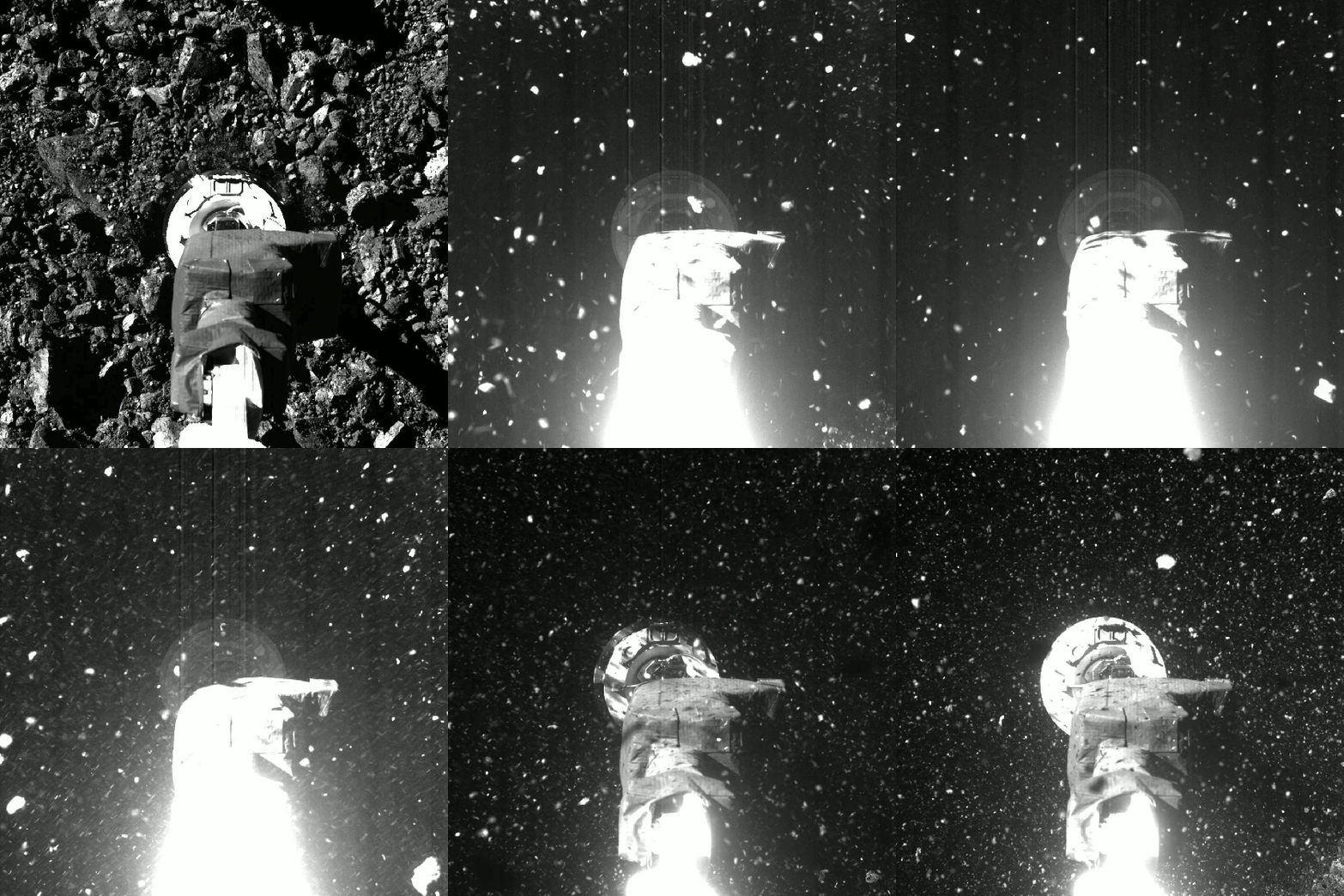
“I must have watched about a hundred times last night,” said Dante Lauretta, the missions’s principal investigator, during a press conference yesterday, while talking about a video clip recorded by the probe during its harrowing maneuver, seen below. “We really did make a mess on the surface of this asteroid, but it’s a good mess.”

NASA/Goddard/University of Arizona

Asteroids are more than just space debris—they are some of the oldest, most pristine samples known of the early solar system. Studying their elemental composition can yield clues to planetary formation, cosmic chemistry and even the emergence of life on Earth. But first you’ve got to get a sample of them, and that’s where OSIRIS-REx—for Origins, Spectral Interpretation, Resource Identification, Security-Regolith Explorer—comes in.

The SUV-sized OSIRIS-REx launched in 2016, arriving at Bennu two years later. It went into orbit around the asteroid, studying it in search of a smooth spot with loose soil and few boulders, making sample collection both easy and safe. But NASA investigators almost immediately realized they were out of luck—Bennu’s surface is almost nothing but boulders. Mission planners hoped for a target site hundreds of feet across, but they settled on one in a region near the asteroid’s north pole that they dubbed Nightingale Crater, which measures just 8 m (26 ft).

Collecting a sample from so small a spot would require both smart technology and deft flying. OSIRIS-REx has a 3.3 meter long, three-jointed arm, at the end of which is a circular sample collector about 0.3 m across dubbed TAGSAM—for Touch and Go Sample Acquisition Mechanism. The flight plan called for the spacecraft to extend its sample arm and then descend from orbit, slowing its speed to just 10 cm/second (0.2 mph) until the TAGSAM assembly made contact with the surface. At that point, nitrogen bottles in the TAGSAM would fire, blasting loose soil and rocks and forcing them into a collection chamber. After just a few seconds, the spacecraft would execute the go part of the touch-and-go maneuver, backing away with its sample secured.

That’s the way it was supposed to go—and that’s exactly the way it did go. TAGSAM was in contact with the surface of Bennu for six seconds, and collected material for five—the greatest share within the first three seconds. It took 18.5 minutes for the signal that the maneuver was a success to travel the 322 million km to Earth. Only once it arrived did NASA Administrator Jim Bridenstine release a triumphal statement.

“This amazing first for NASA demonstrates how an incredible team from across the country came together and persevered,” he said. “Our industry, academic, and international partners have made it possible to hold a piece of the most ancient solar system in our hands.”

The question is, how big is that piece? The TAGSAM collector can accommodate up to 2 kg (4.4 lbs) of material; mission leaders want at least about 60 gm (2.1 oz). Later today, the collector arm will move to put the TAGSAM in front of one of the spacecraft’s cameras, thus giving NASA engineers a better look. A more accurate measurement will be taken on Saturday, when the collector arm is extended and the spacecraft’s thrusters nudge it into a gentle pirouette. The rate at which it spins from a given amount of thrust will be compared to the rate of spin from the same maneuver conducted before Tuesday’s collection; the more material gathered, the slower the rate of spin will now be. If there’s enough material, the sample will be transferred to a secure reentry capsule, which will be the only part of OSIRIS-REx that will ultimately return to the surface of the Earth.

“We will use the combination of data from…the post-TAG images and mass measurement to assess our confidence that we have collected at least 60 grams of sample,” said project manager Rich Burns in a statement. “If our confidence is high, we’ll make the decision to stow the sample on October 30.”

If their confidence is not high, the team can execute another collection maneuver on Jan.. 12 at a site known as Osprey. Departure from Bennu is set for March 21, with the reentry capsule set to parachute into the Utah desert on Sept. 24, 2023. Only then will the little bit of rock and dirt from the seven-year, $800 million mission be in the hands of the scientists. And only then will we begin to reveal the secrets that Bennu may hold.

martes, 20 de octubre de 2020

New story in Science and Health from Time: UK Plans ‘Challenge Trials,’ Which Will Intentionally Give People COVID-19 to Test Vaccines UK Plans ‘Challenge Trials,’ Which Will Intentionally Give People COVID-19 to Test Vaccines


On Oct. 20, researchers at the Imperial College of London announced plans for the first human challenge study of COVID-19, which involves deliberately infecting volunteers with the virus that causes the disease, in order to test the effectiveness of vaccines.

The strategy is controversial, as researchers have to weigh the risks of infection against the benefits of learning how well the various vaccine candidates can fight that infection. The strongest argument in favor of the studies has to do with time. If cases of COVID-19 are waning, then the likelihood that people who are vaccinated would get exposed to and potentially infected with the virus naturally declines as well, and it takes researchers longer to accumulate enough data to tell if a vaccine is effective or not. By intentionally exposing people to the virus after they have been vaccinated, researchers can shrink this timeline significantly.

Scientists have used the model to test vaccines against a number of different diseases, including the very first one against smallpox—Edward Jenner infected his son with cowpox, and then exposed his son to smallpox as a way to test his theory that exposure to the former would protect his son from infection by the latter. Scientists tested an H1N1 influenza vaccine by exposing people to the flu, and did the same with a cholera vaccine and the bacterium that causes it. But the strategy requires a solid base of information about both the disease and the vaccine in order to justify the risks. More recently, for example, scientists considered intentionally infecting volunteers with the Zika virus to test vaccines against that disease, but ultimately decided they didn’t have enough data to justify the risk.

Adair Richards, honorary associate professor at the University of Warwick who last May published guidelines on how to ethically conduct human challenge studies, notes that during a pandemic, the risk of delays in developing treatments should be considered alongside the risks to volunteers who are intentionally exposed to disease. “There is a moral weight to inaction as well as action,” he says. “There is an unseen risk if we don’t do [these studies]. We send a lot of doctors, nurses and care workers to work every day, and some will get really sick and die of COVID-19 in the next few weeks. [Those] few weeks count—that’s the unseen risk.”

More than 38,000 people in the U.S. agree, and have registered their intention to volunteer for challenge studies on 1DaySooner.org, an online recruiting group—despite the fact that no such studies have been planned in the country yet.

The London-based scientists still need to submit a detailed proposal to regulatory agencies on how they could conduct their study. If the proposal is approved, the team won’t start exposing any volunteers until January. Before that, they will first need to determine what dose of SARS-CoV-2, the virus that causes COVID-19, is safe to give to people but can still produce enough disease to test a vaccine. They will start with the smallest possible dose and work up to one that balances safety with the ability to trigger a proper immune response. The participants will remain under quarantine at a designated facility in London until they test negative for the virus, the researchers said.

From a scientific perspective, infecting people with a known dose of the virus can help researchers be more precise about evaluating and comparing people’s immune responses to different vaccines. It will also provide those answers faster than waiting for people to be exposed naturally infected with the disease. “These could almost take the place of phase 3 trials or at least go alongside them,” says Richards.

That speed is one reason why the 1DaySooner.org volunteers have supported human challenge trials. “We could know already if some of the major vaccines in phase 3 trials are actually effective,” says the movement’s founder Josh Morrison, who also co-founded Waitlist Zero, and advocacy group for living organ donors. “It’s not to say that we wouldn’t still need phase 3 studies, but we would obviously be in a much better position if we could say that when we vaccinate healthy young people with this vaccine and then challenge them with virus, it’s 80% effective or 60% effective or 20% effective or not effective at all. It’s useful information we could have now but don’t have.”

Exposing people deliberately to a disease-causing virus, however, would only make sense if the chances of naturally being infected is low, and would delay results of vaccine trials. That’s one issue regulators in the UK will likely consider before approving the plan, as daily case numbers there continue to climb. That’s also the case in the U.S., where new infections continue to emerge at high rates in many parts of the country. That’s one of the main reasons that Dr. Anthony Fauci, director of the National Institute of Allergy and Infectious Diseases (NIAID) and member of the White House Coronavirus Task Force, said earlier this year that the studies are not ethically justified—at the time, mid-July, daily case numbers were peaking.

In an Oct. 20 statement to TIME, NIAID officials said the agency is “currently prioritizing randomized controlled clinical trials to evaluate the safety and efficacy of SARS-CoV-2 vaccine candidates. Should there be a need for human challenge studies to fully assess candidate vaccines or therapeutics for SARS-CoV-2, NIAID has begun efforts to manufacture a virus strain that could be used to develop a human challenge model, if needed, although human challenge trials would not replace Phase 3 trials.”

Any human challenge study has to be done with extreme caution, says Richards. His guidelines include giving people a mandatory period of time to think about their decision to ensure they are making the choice freely and without any duress, and that the risks of infection are conveyed in a straightforward and easily understandable way. Any financial payment should be minimal to cover time away from work and any expenses related to being quarantined for the study, but not large enough to bias people’s decisions. “We also want participants to be screened for mental health conditions and cognitive capacity,” he says, to ensure that they are making their decision to join the study autonomously.

The Imperial College of London team has yet to detail how its study volunteers will be managed, and what type of informed consent they will provide, but the announcement could change the discussion about the feasibility and utility of human challenge studies. Having studies that compare people’s immune responses to different vaccines could be useful in prioritizing which vaccines are manufactured in greater quantities. “Even if every vaccine currently in phase 3 trials works very well, we won’t be able to produce enough doses to vaccinate the whole world in 2021,” says Morrison. “It’s important that we are getting better vaccines and learning from the science and challenge studies are going to be quite useful for that.”

New story in Science and Health from Time: The Antarctic Ocean Is in Climate Crisis. This Week, the World Could Take a Big Step Towards Protecting Its Future The Antarctic Ocean Is in Climate Crisis. This Week, the World Could Take a Big Step Towards Protecting Its Future


Sixty years ago a dozen nations, including arch-rivals the United States and the Soviet Union, agreed to preserve the Antarctic continent as a place of peace, research and conservation. Commercial exploitation of its resources and its animals was forbidden. Yet much of the ocean that surrounds the territory does not have the same protections.

This will be up for discussion during a virtual meeting of the Convention for the Conservation of Antarctic Marine Living Resources (CCAMLR) from 22-30 October. The Convention is meeting to discuss the region’s future and will decide whether or not it’s time to give some of the most biodiverse seas around Antarctica the same defenses as the land itself.

The timing couldn’t be more vital. The combined threats of global climate change and industrial fishing are weakening the crucial ecosystems that lie within its waters. Record high temperatures are breaking up ice sheets that have lasted millennia. On Feb. 6, a weather station on the Antarctic Peninsula—the 1,500 km long finger of land that reaches towards South America—reported a record temperature high of 18.3°C. While members of a nearby scientific expedition researching penguin populations relished in the balmy weather, stripping down to t-shirts and bare chests, it was an ominous sign for a species better adapted to ice. Just a few days earlier the penguin researchers were reporting a 77% decline in some colonies.

The peninsula isn’t just one of the fastest warming places on earth. It’s also home to some of the most exquisitely specialized species on the planet. Among them is Antarctic krill—the tiny, shrimp-like crustaceans that collectively form the largest biomass on the planet and are the cornerstone of the global ocean food chain. Yet the encroachment of industrial fisheries into these waters is threatening their health, as well as the penguins, seals and whales that are sustained by them.

Read More: Why This Year Is Our Last, Best Chance for Saving the Oceans

CCAMLR was established in 1982 with a mandate to protect Antarctic marine life through sustainable fisheries. It governs by consensus, and regulates fishing through quotas. The current quota for krill across the entire fishing fleet is limited to less than .5% of the known biomass. That may not sound like much, but it can still have an outsize impact depending on where the krill is harvested, says Rodolfo Werner, an Argentina-based marine biologist who is currently advising the Pew Charitable Trust’s Antarctic Krill Conservation Project.

“The question is not how much krill you catch, but when you catch it and where,” Werner says. Over the past decade, he says, the fishing fleets have been moving closer to areas around the Antarctic Peninsula that are used by penguins to forage during the breeding season. Seals and whales also compete for krill along those coasts, leading to even greater uncertainty about how much, exactly, is there. “It’s hard enough trying to determine how much krill we can allow the fisheries to take,” he says by phone. “When you throw in climate change and sea ice reduction, it gets even more complicated.”

Rather than work by quotas, he says, a better solution would be to limit fishing access entirely in vital areas. And he is not the only one. The European Union, along with most other CCAMLR members, is calling for the entire Antarctic Peninsula —the northernmost tip of the sprawling continent— to be set aside as a Marine Protected Area (MPA), meaning that the area will be off limits for all kinds of commercial exploitation. The call is part of a global drive to set aside a full 30% of the oceans as conservation areas, where fish stocks and marine animals can recover from decades of overfishing, and go on to repopulate the rest of the ocean. Marine conservationist Cristina Mittermeier calls them “fish banks,” that grow with compound interest over time.

In 2011 CCAMLR committed to establish a network of nine large-scale marine protected areas around Antarctica. A decade later, only two have been implemented, including one at the Ross Sea that is twice the area of Texas and the largest such region in the world. This year the organization will consider a proposal by Argentina and Chile to create an MPA to protect a large section of the Antarctic Peninsula region, along with one for East Antarctica and another for the Weddell Sea.

The problem is that up until now, CCAMLR members Russia and China have blocked the proposals. Both countries are intent on expanding their regional fishing operations, and while MPAs won’t affect their quota, “China doesn’t want any restriction on access to resources anywhere,” says Werner, who has served on CCAMLR’s scientific committee for the past 17 years. “Setting up an MPA in Antarctica sets a precedent that could be replicated elsewhere on the high seas, and they see that as a threat to their sovereignty.”

What happens on this remote continent will reverberate around the world, says Andrea Kavanagh, project director for the Pew Charitable Trust’s Protecting Antarctica’s Southern Ocean campaign. An MPA on its own can’t stop the impact of warming seas or plastic pollution, but by offering marine life respite from fishing pressures, it helps build resilience.

“Designating the Antarctic Peninsula MPA would create a climate refuge for krill and penguins and could permanently protect the region’s unique marine ecosystem,” says Kavanagh. Not only that, it can help mitigate the effects of climate change. When krill feed on phytoplankton, their carbon-rich waste sinks to the bottom of the ocean, where it stays for thousands of years. Scientists estimate that they sequester some 23 million tons of carbon emissions each year, equivalent to the output of six coal-fired power plants.

Together, the East Antarctica, Antarctic Peninsula, and Weddell Sea MPAs would protect close to 1% of the ocean globally by covering approximately four million square kilometers. “Establishing this network of MPAs could be the single greatest act of ocean conservation in humankind, making this the greatest sanctuary on earth,” says Mittermeier, whose organization SeaLegacy.Org is leading a petition campaign in support of the MPAs. “If we can’t protect the most wild place on the planet, how can we protect ourselves?”

martes, 13 de octubre de 2020

New story in Science and Health from Time: Russian-U.S. Crew Launches on Fast Track to the Space Station Russian-U.S. Crew Launches on Fast Track to the Space Station


(MOSCOW) — A trio of space travelers has launched successfully to the International Space Station, for the first time using a fast-track maneuver to reach the orbiting outpost in just three hours.

NASA’s Kate Rubins along with Sergey Ryzhikov and Sergey Kud-Sverchkov of the Russian space agency Roscosmos lifted off as scheduled Wednesday morning from the Russia-leased Baikonur space launch facility in Kazakhstan for a six-month stint on the station.

For the first time, they are trying a two-orbit, three-hour approach to the orbiting space outpost. Previously it took twice as long for the crews to reach the station.

They will join the station’s NASA commander, Chris Cassidy, and Roscosmos cosmonauts Anatoly Ivanishin and Ivan Vagner, who have been aboard the complex since April and are scheduled to return to Earth in a week.

Speaking during Tuesday’s pre-launch news conference at Baikonur, Rubins emphasized that the crew spent weeks in quarantine at the Star City training facility outside Moscow and then on Baikonur to avoid any threat from the coronavirus.

“We spent two weeks at Star City and then 17 days at Baikonur in a very strict quarantine,” Rubins said. “During all communications with crew members, we were wearing masks. We made PCR tests twice and we also made three times antigen fast tests.”

She said she was looking forward to scientific experiments planned for the mission.

“We’re planning to try some really interesting things like bio-printing tissues and growing cells in space and, of course, continuing our work on sequencing DNA,” Rubins said.

Ryzhikov, who will be the station’s skipper, said the crew will try to pinpoint the exact location of a leak at a station’s Russian section that has slowly leaked oxygen. The small leak hasn’t posed any immediate danger to the crew.

“We will take with us additional equipment which will allow us to detect the place of this leak more precisely,” he told reporters. “We will also take with us additional improved hermetic material which will allow to fix the leak.”

In November, Rubins, Ryzhikov and Kud-Sverchkov are set to greet NASA’s SpaceX first operational Crew Dragon mission, bringing NASA astronauts Mike Hopkins, Victor Glover and Shannon Walker, and Japan Aerospace Exploration Agency astronaut Soichi Noguchi to the space station aboard the Crew Dragon vehicle. It follows a successful Demo-2 mission earlier this year.

The Crew Dragon mission was pushed back from Oct. 31 into November, and no new date has been set yet. The delay is intended to give SpaceX more time to conduct tests and review data from an aborted Falcon 9 launch earlier this month.

viernes, 9 de octubre de 2020

New story in Science and Health from Time: ‘It’s a Game for Them.’ Scientists Around the World Are Teaching Dogs to Sniff Out COVID-19 ‘It’s a Game for Them.’ Scientists Around the World Are Teaching Dogs to Sniff Out COVID-19


Steve Lindsay, a public health entomologist at Durham University, is midway through explaining how dogs might play a role in detecting COVID-19 infections when a decidedly less-well trained canine interrupts our conversation.

“If you’ll excuse me for a minute, I’ve got a naughty black Labrador out in the back garden doing something it shouldn’t be doing,” Lindsay says. He disappears. I hear barking. He returns accompanied by a chocolate lab. “She’s not as skilled as the detection dogs,” Lindsay says as the pup tries to lick his face. “But it’s really interesting to see how a dog sees the world through its nose. It’s amazing actually.”

It’s that olfactory prowess that could make dogs a useful ally in our battle against a virus that’s killed over 1 million people worldwide. Scientists have long known that people sick with certain diseases emit particular odors—different infections affect different parts of the body in different ways, often producing specific combinations of volatile compounds. Dogs have shown a remarkable ability to pick up on those airborne chemicals, detecting when people are infected with malaria, infectious bacteria, and even certain types of cancer. Now scientists are hoping that dogs’ keen sense of smell, 10,000 times better than that of humans, can help them identify people carrying COVID-19, too.

Lindsay, along with collaborators at the London School of Hygiene & Tropical Medicine (LSHTM) and the U.K.-based nonprofit Medical Detection Dogs, is working on a U.K. government-funded study that will test dogs’ ability to detect COVID-19. Their goal: to train coronavirus-sniffing dogs, which could then be deployed at schools, airports and other public venues to reinforce existing nasal swab testing programs. A similar study is underway at the University of Pennsylvania.

“We’re not just doing the proof of concept work, we’re also working out actively how to deploy this and scale it up as well, because we want to hit the ground running once we’ve gotten our results,” says James Logan, the head of LSHTM’s Department of Disease Control and the project lead on the U.K. study.

Other studies have produced promising, albeit early, results. In June, a team in France using a small number of samples collected from human patients who had been tested for COVID-19 in PCR tests (the current gold standard for testing) found a high degree of evidence that dogs could detect COVID-19 infections through differences in the smell of human subjects’ armpit sweat. (Also concluded: dogs don’t particularly mind sniffing people’s armpits.) In Germany, researchers ran a small pilot study, published in July, with trained coronavirus-sniffing dogs—corona-schnüffelnder hunde—and showed that the dogs were able to distinguish between coronavirus-positive samples and a control group with an average sensitivity (the rate of detecting true positives) of 83% and a specificity (true negative rate) of 96% after only one week of training. That’s not quite as accurate as COVID-19 rapid antigen tests, which have a sensitivity ranging from 84% to nearly 98% and specificities of 100%. But antigen tests require often uncomfortable nasal swabs, and take about 15 minutes to return results. Dogs, by contrast, may be able to tell if a person is infected in seconds, no swab needed.

“It’s a game for them,” says Holger Volk, a co-author on the German study and the head of small-animal medicine and surgery at the University of Veterinary Medicine, Hannover. In that study, researchers used a device called a Detection Dog Training System, which randomly presented dogs with either COVID-19 positive or negative samples via a row of seven “scent holes” connected to sample containers. The dogs were automatically rewarded with a toy or food when they identified the correct samples. “It’s a positive experience for the dogs as well, and that’s why they learn so fast,” says Volk.

Coronavirus sniffing dogs are already in use at Helsinki-Vantaa Airport as part of a Finnish government-sponsored pilot program; canines are also currently scanning for COVID-19 in multiple airports in the U.A.E. Despite those deployments, there’s still plenty we don’t know about dogs’ ability to detect COVID-19. It remains unclear how strong any coronavirus odor smells to dogs, for instance. If sniffer dogs are sensitive to coronavirus smells, handlers could keep the animals near moving lines of people, checking lots of subjects at once—similar to how explosive-sniffing dogs work at airports. If not, sniffer dogs may only be able to pick up the scent when scanning people one at a time. Another unknown: how far a COVID-19 infection needs to progress before a dog can pick up the scent. The German study, for instance, used samples from hospitalized coronavirus patients, who were likely sicker than many people who get infected; about 40% of people with the virus show no symptoms, but may still spread it to others.

“What we want particularly is for our dogs to be picking up asymptomatic people,” says Lindsay, whose study aims to test dogs’ abilities on people presenting various degrees of symptoms. “If they do that, that’s even better because we’ll pick up people early.”

Another open question is whether dogs trained to detect COVID-19 are zeroing in on the infection caused by the SARS-CoV-2 virus specifically, or if they’re detecting a broader array of similar viral infections, like seasonal flu and colds. “Like a recipe, if you get one ingredient wrong it doesn’t give you the right taste,” says Logan. His team wants to answer that question in further research, assuming they get more funding.

While researchers are optimistic that dogs may play some role in helping fight the pandemic, they’re clear-eyed about the need for more evidence that such a plan will actually work. “There are a number of projects around the world that are moving forward with deploying COVID-19 dogs, and this is happening a little bit before the robust evidence is in place,” says Claire Guest, the CEO of Medical Detection Dogs. Getting more conclusive results will mean collecting hundreds of samples to make sure dogs are learning the scent of COVID-19 infection and not just the smell of individual patients. That sometimes means getting creative; the U.K-based research team is currently collecting socks worn by COVID-19 positive patients and others worn by healthy participants to use in its trials. Guest hopes her group will be ready to publish results based on this next research phase in the next six to eight weeks. If their findings check out, researchers say we could see COVID-19 detection dogs deployed more widely within six months.

jueves, 8 de octubre de 2020

New story in Science and Health from Time: Camera Designed by Felix & Paul Studios and TIME Arrives at ISS to Capture First-Ever Virtual Reality Spacewalk Camera Designed by Felix & Paul Studios and TIME Arrives at ISS to Capture First-Ever Virtual Reality Spacewalk


It’s entirely possible you missed it, but on Oct. 2 at 9:16 PM ET, you lifted off for the International Space Station. Just over two days later, you docked successfully—and it’s a good thing you did. You’ve got a spacewalk planned for later this year.

O.K., technically speaking, you didn’t go anywhere at all, and unless you’re actually a highly-trained astronaut, you certainly shouldn’t be planning for a real-deal spacewalk—or extravehicular activity (EVA)—any time soon. But you could very much share in the experience when actual ISS crew members venture outside of the station for one of the most exciting and dangerous experiences an astronaut can have.

That’s because something special was included among the ISS-bound cargo on the uncrewed Cygnus supply vehicle that took off from Wallops Island, Va. earlier this week: the first-ever 3D, virtual reality camera designed to operate in the vacuum of space. It’s the product of a partnership between the Montreal-based Felix & Paul Studios (an Emmy Award-winning creator of immersive entertainment experiences), TIME Studios (TIME’s Emmy Award-winning television and film division) and Nanoracks (the leading provider of commercial space access).

The Space Camera is loaded before it was launched to the International Space Station
Philip Andrews—for TIMEThis photograph was taken inside the mobile clean room attached to Northrop Grumman’s Antares rocket as it rests atop Pad 0A at NASA’s Wallops Flight Facility in Wallops, Island, Va. on Sept. 28, 2020. Mechanical Technician Stephen Busch, left, and Jennie Wang, Lead Integration and Test Mechanical Engineer for Northrop Grumman, load the cargo bag containing the Space Camera through the hatch of the Cygnus Pressurized Cargo Module. The vehicle successfully docked with the International Space Station on October 5.

The new camera is not the first one TIME, Felix & Paul and Nanoracks have sent to the ISS. In 2016, TIME and Felix & Paul were independently exploring the possibility of such a project, and ultimately decided to collaborate rather than compete. The decision bore fruit when, just two years later when we launched a camera built to operate inside the ISS. It’s been shooting scenes of station life for TIME’s The ISS Experience, set for release on Oct. 22 for virtual reality headsets via the Oculus Store. The episodes will also be available later in the fall in select domes and planetariums around the country, and in 360° mobile format through 5G-enabled wireless carriers.

Designing a multi-lens camera that could shoot in 3D and VR and function in the microgravity of low-Earth orbit was challenge enough. Designing one that can function in the extreme environment outside the ship—where temperatures fluctuate from 121º C (250º F) to -156º C (-250º F), and where 16 sunrises and sunsets a day can produce extreme flaring on the camera’s lenses—was an order of magnitude harder.

The camera was hardened by Nanoracks to withstand not only the temperature variations and the solar flaring, but also ultraviolet radiation, charged particle (ionizing) radiation, plasma, surface charging and arcing, and impacts from micrometeoroids and orbital debris. “This may well be one of the most complex and exciting projects that we have ever worked on at Nanoracks,” says Conor Brown, senior manager of the company’s program office.

Adds Jonathan Woods, executive producer for The ISS Experience at TIME Studios and Emmy-winning producer of A Year in Space: “Getting this camera to space was the culmination of five years of exceedingly hard work. Only 228 humans have ever conducted a spacewalk. It’s one of the most thrilling yet perilous tasks an astronaut can undertake.”

The astronauts whose spacewalk will be recorded for The ISS Experience will not have to worry about managing the camera themselves. Instead it will be mounted on the Canadarm 2, the station’s 17.6 m (58 ft) remote manipulator arm that can be operated by astronauts within the station, capturing the experience of those who are working outside. TIME will provide updates on when the first EVA to be filmed will take place, and when the footage will be released for viewing. The experience should be a profound one.

“Our space camera,” says Félix Lajeunesse, co-founder of Felix & Paul Studios, “purpose-built to capture this historic event in fully-immersive 3D, brings us one step closer to our goal of taking billions of minds to space, and having them experience a spacewalk as if they were astronauts themselves.”