jueves, 19 de noviembre de 2020

New story in Science and Health from Time: COVID-19 Vaccines Are Coming. Here’s What to Expect COVID-19 Vaccines Are Coming. Here’s What to Expect


Vaccines normally take decades to develop and test, but two COVID-19 shots, from Moderna and Pfizer (in partnership with BioNTech), have gone from nonexistent to about 95% effectiveness in 10 months. Public-health officials and governments now have the dual challenge of convincing the public that the vaccines are both safe and scientifically sound, as well as figuring out how to distribute billions of doses. Here’s what we know so far about how that’s going.

When can I get vaccinated?

That depends.

Manufacturers have already begun producing vaccines, betting that they will be effective, so they can be ready to ship if the FDA authorizes them, possibly as soon as December. Still, doses will be limited this year and will be reserved for those at highest risk of infection, such as health care workers as well as those with essential jobs, like first responders and law-enforcement personnel. As vaccine manufacturers fire up production, more people, including those with chronic health conditions, and the elderly, will be able to get immunized. Dr. Anthony Fauci, director of the National Institute of Allergy and Infectious Diseases, says it may not be until spring that most Americans can start to get vaccinated.

Who approves the vaccines?

The Food and Drug Administration must approve any vaccine. But most COVID-19 vaccine makers won’t initially apply for normal approval, which typically requires six or more months of follow-up study. Instead, they will likely ask for emergency-use authorization (EUA), which makes it possible to release new drugs and vaccines during a health emergency. For an EUA, the FDA has said companies should monitor trial participants for two months to make sure the vaccines are safe and don’t lead to serious side effects. All of the testing and other requirements for evaluating safety and effectiveness remain the same for an EUA as for full approval. Many vaccine makers plan to apply for full approval of their shots once they accumulate the appropriate amount of follow-up data.

Were shortcuts taken to develop these vaccines?

According to leading public-health experts and the vaccine makers, the same rigorous scientific process that goes into developing any vaccine was used to create the COVID-19 shots. But in some cases, new technology like the mRNA-based technique used by Moderna and Pfizer—the first two companies to finish human testing—have sped up the development process. The mRNA method doesn’t require researchers to grow or manipulate SARS-CoV-2, the virus responsible for COVID-19; all they need is its genetic sequence, which Chinese scientists released in January. The technology is both fast and flexible, and allowed vaccine makers to develop and start testing their vaccines in a matter of months.

If I get vaccinated, does that mean that I can’t get infected?

Not necessarily.

But it means you are less likely to get sick. When Pfizer announced that its vaccine was more than 95% effective and Moderna said its shot was 94.5% effective, that was how well they kept people from getting sick. In the studies, people were randomly assigned to get the vaccine or a placebo. If anyone in either group felt symptoms of COVID-19 (including fever, cough, headache and difficulty breathing), they reported it to the researchers, who then decided whether to test for COVID-19. So the studies did not test everyone to see how many people in the vaccinated group got infected compared with the placebo group. Instead, the scientists took those participants who tested positive for COVID-19 and compared how many in the vaccinated group went on to develop disease and how many in the placebo group did. The companies will continue to test people in the studies for antibodies to the COVID-19 virus, which would include people who did not show any symptoms of their infection, so they can get a better sense of whether or not the vaccines protect against not only getting sick but also against infection.

Are all the vaccines made the same way?

No.

The various companies are relying on different technologies. Moderna and Pfizer use the mRNA technology based on the pandemic virus’s genetic code. The AstraZeneca and University of Oxford team, as well as Johnson & Johnson/Janssen, are relying on different inactivated cold viruses loaded with COVID-19 viral genes that can produce viral proteins to activate the immune system, while both Novavax and the Sanofi/GlaxoSmithKline partnership are producing and then introducing proteins from the virus itself to trigger an immune response. All are close to completing testing of their shots.

Where can I get vaccinated?

In the first few months after the initial doses are shipped, there will likely be a limited number of ­providers—mostly in public-health clinics and major hospitals. But the federal government has authorized pharmacists to administer COVID-19 vaccines, so eventually retail pharmacies, community health centers and other locations will be offering COVID-19 shots.

Can I choose which vaccine I get?

Probably not.

State health departments will likely be coordinating the ordering and distribution of doses, and they won’t know which vaccines they will receive. Some health departments may request certain vaccines depending, for example, on factors such as whether some of their vaccine facilities have the proper storage equipment like the ultra-cold freezers needed for Pfizer’s vaccine, or perhaps whether the shots show any differences in effectiveness among people of different ages, ethnicities or health conditions. So far, the Moderna and Pfizer vaccines don’t show such distinctions, so they will likely be shipped out based on proposals that state health departments have submitted for how many doses they will need. Although Pfizer’s vaccine needs to be stored at –70°C, the company plans to ship its doses in thermal packaging that can maintain that temperature for up to 15 days, as long as users replenish the dry ice included in the packaging.

Why do I need two doses of vaccine?

All of the COVID-19 vaccines being tested, with the exception of Johnson & Johnson/Janssen’s, require two doses. That’s because researchers found that while the body launches an immune response after the first dose, boosting that initial exposure to the virus magnifies that defense significantly. If a person hasn’t been infected by the COVID-19 virus, it takes a little longer to prime the pump of their immune system against it.

Will I have to pay for a COVID-19 vaccine?

Vaccines supported by U.S. taxpayer dollars under the Operation Warp Speed ­program—which includes those from AstraZeneca, Johnson & Johnson/Janssen, Moderna, Pfizer/BioNTech, Sanofi/GlaxoSmithKline and others—should be free for all Americans, although the details of the purchasing contracts are still unclear. Some health facilities may also charge an administration fee for giving the vaccine, which people will have to pay out of pocket.

Will I still have to wear a mask after I get vaccinated?

Yes.

Studies so far show only that the vaccines can protect against getting sick with the disease, and may not prevent being infected with the virus. So it’s important to still follow all the public-health measures that throw up an invisible wall against the coronavirus. Even if you’re immunized, you can still get infected with the virus and therefore pass it on to others. That’s why even as more and more people get vaccinated, health officials will continue to ask you to wear a mask in public, practice social distancing and avoid large indoor gatherings. Those basic behaviors will remain critical in keeping the virus from finding new hosts.

lunes, 16 de noviembre de 2020

New story in Science and Health from Time: The SpaceX Capsule With Four Astronauts On Board Has Reached the International Space Station The SpaceX Capsule With Four Astronauts On Board Has Reached the International Space Station


CAPE CANAVERAL, Fla. — SpaceX’s newly launched capsule with four astronauts arrived Monday at the International Space Station, their new home until spring.

The Dragon capsule pulled up and docked late Monday night, following a 27-hour, completely automated flight from NASA’s Kennedy Space Center.

“Oh, what a good voice to hear,” space station astronaut Kate Rubins called out when the Dragon’s commander, Mike Hopkins, first made radio contact. The linkup occurred 262 miles (422 kilometers) above Idaho.

This is the second astronaut mission for SpaceX. But it’s the first time Elon Musk’s company delivered a crew for a full half-year station stay. The two-pilot test flight earlier this year lasted two months.

The three Americans and one Japanese astronaut will remain at the orbiting lab until their replacements arrive on another Dragon in April. And so it will go, with SpaceX — and eventually Boeing — transporting astronauts to and from the station for NASA.

This regular taxi service got underway with Sunday night’s launch.

Hopkins and his crew — Victor Glover, Shannon Walker and Japan’s Soichi Noguchi — join two Russians and one American who flew to the space station last month from Kazakhstan. Glover is the first African-American to move in for a long haul. A space newcomer, Glover was presented his gold astronaut pin Monday.

The four named their capsule Resilience to provide hope and inspiration during an especially difficult year for the whole world. They broadcast a tour of their capsule Monday, showing off the touchscreen controls, storage areas and their zero gravity indicator: a small plush Baby Yoda.

Walker said it was a little tighter for them than for the two astronauts on the test flight.

“We sort of dance around each other to stay out of each other’s way,” she said.

For Sunday’s launch, NASA kept guests to a minimum because of coronavirus, and even Musk had to stay away after tweeting that he “most likely” had an infection. He was replaced in his official launch duties by SpaceX President Gwynne Shotwell, who assured reporters he was still very much involved with Sunday night’s action, although remotely.

As they prepared for the space station linkup, the Dragon crew beamed down live window views of New Zealand and a brilliant blue, cloud-streaked Pacific 250 miles below.

“Looks amazing,” Mission Control radioed from SpaceX headquarters in Hawthorne, California.

“It looks amazing from up here, too,” Hopkins replied.

___

The Associated Press Health and Science Department receives support from the Howard Hughes Medical Institute’s Department of Science Education. The AP is solely responsible for all content.

New story in Science and Health from Time: SpaceX’s Crewed Launch Continues What NASA’s Gemini Astronauts Started SpaceX’s Crewed Launch Continues What NASA’s Gemini Astronauts Started


We’re not sure if Jim Lovell and Buzz Aldrin were watching Sunday when SpaceX’s Crew Dragon lifted off from Pad 39A at Cape Canaveral for its first fully operational mission—but the odds are pretty good that they were. Astronauts from past eras of space travel tend to keep up with the doings in the modern one. Either way, the overall audience for the launch was big—NASA’s site carried it live, as did the cable news channels. But of all the people who were watching, it was Lovell and Aldrin whose attention would be the most important, or at least the most poignant.

Fifty-four years earlier to the day, in 1966, the pair splashed down in the Atlantic Ocean northeast of Turks and Caicos after a nearly four day, 59-orbit mission in their Gemini 12 spacecraft. The flight was close to flawless. The crew successfully docked with an uncrewed Agena spacecraft, and Aldrin logged more than five hours outside the Gemini over the course of three separate spacewalks. The tenth and final flight of the Gemini series, it was by any measure a perfect capstone.

“In 10 manned Gemini missions since March, 1965,” read the next day’s New York Times, “Gemini astronauts demonstrated their ability to rendezvous and link up with target vehicles, fire a target Agena’s rocket to climb to a record altitude, fly for 14 days without any ill effects and bring their crafts to precise landings.”

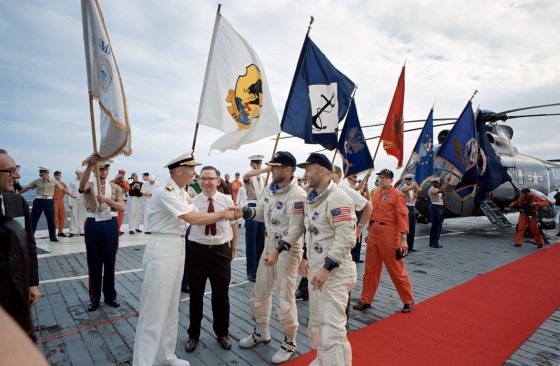
NASAAstronauts James A. Lovell Jr. (left), command pilot, and Edwin E. Aldrin Jr., pilot, receive official welcome as they arrive aboard the aircraft carrier USS Wasp. Gemini-12 splashed down in the Atlantic Ocean recovery area at 2:21 p.m. (EST), Nov. 15, 1966.

All of those achievements were essential dress rehearsals for getting astronauts to and from the moon. But the success of the Gemini program was as much about hardware as it was about piloting acumen. Those 10 flights over the course of 20 months factored out to one crewed mission every eight weeks, with Geminis rolling off the assembly line at McDonnell Aircraft Corporation in St. Louis, getting mounted atop their Titan boosters and rocketing into space with a regularity that was unimaginable only a few years earlier.

SpaceX is aiming to achieve a similar gas-up-and-go capability—and in some ways it already has, with more than 100 launches in its various fleet of rockets since 2010. But only two so far have been crewed: the current four-person mission, and the first, experimental one, which carried two astronauts to the International Space Station (ISS) back in May. Because space station crews stay aloft for six months at a time, there is no need for the company to match Gemini’s pace. But with crew members’ lives on the line, it is very much aiming for the same reliability—a thought echoed by outgoing NASA Administrator Jim Bridenstine after this weekend’s launch.

“This is another historic moment,” he said. “[But] make no mistake: Vigilance is always required on every flight.”

NASA learned that lesson in the worst of all possible ways just over two months after Gemini 12’s successful return, when the Apollo 1 astronauts died in a launch pad fire early in the evening of Jan. 27, 1967. At the moment the men were killed, Lovell and a contingent of other astronauts were at the White House, mingling with dignitaries celebrating the ratification of the 1967 Outer Space Treaty, which bound signatory nations to keep weapons of mass destruction out of space, to refrain from militarizing the moon or other celestial bodies and to render aid to other countries’ astronauts in distress. Just three years after that tragic evening, Lovell himself was very much in distress, when the Apollo 13 spacecraft he was commanding suffered a crippling explosion en route to the moon, nearly claiming the lives of another Apollo crew.

Space—as people say over and over—is hard, but the shopworn nature of the phrase makes it no less true. Nov. 15, 2020 was a very, very good day for SpaceX and the nation as a whole. We will need many more good days to see that space continues to be explored routinely, reliably and, far and away most importantly, safely.

New story in Science and Health from Time: Early Data Suggests Moderna’s COVID-19 Vaccine Is Nearly 95% Effective—And You Can Keep It in the Fridge Early Data Suggests Moderna’s COVID-19 Vaccine Is Nearly 95% Effective—And You Can Keep It in the Fridge


For the second time this month, there’s promising news from a COVID-19 vaccine candidate: Moderna said Monday its shots provide strong protection, a dash of hope against the grim backdrop of coronavirus surges in the U.S. and around the world.

Moderna said its vaccine appears to be 94.5% effective, according to preliminary data from the company’s still ongoing study. A week ago, competitor Pfizer Inc. announced its own COVID-19 vaccine appeared similarly effective — news that puts both companies on track to seek permission within weeks for emergency use in the U.S.

Dr. Stephen Hoge, Moderna’s president, welcomed the “really important milestone” but said having similar results from two different companies is what’s most reassuring.

“That should give us all hope that actually a vaccine is going to be able to stop this pandemic and hopefully get us back to our lives,” Hoge told The Associated Press.

“It won’t be Moderna alone that solves this problem. It’s going to require many vaccines” to meet the global demand, he added.

A vaccine can’t come fast enough, as virus cases topped 11 million in the U.S. over the weekend — 1 million of them recorded in just the past week. The pandemic has killed more than 1.3 million people worldwide, more than 245,000 of them in the U.S.

Still, if the Food and Drug Administration allows emergency use of Moderna’s or Pfizer’s candidates, there will be limited, rationed supplies before the end of the year. Both require people to get two shots, several weeks apart. Moderna expects to have about 20 million doses, earmarked for the U.S., by the end of 2020. Pfizer and its German partner BioNTech expect to have about 50 million doses globally by year’s end.

Moderna’s vaccine, created with the National Institutes of Health, is being studied in 30,000 volunteers who received either the real vaccination or a dummy shot. On Sunday, an independent monitoring board broke the code to examine 95 infections that were recorded starting two weeks after volunteers’ second dose — and discovered all but five illnesses occurred in participants who got the placebo.

The study is continuing, and Moderna acknowledged the protection rate might change as more COVID-19 infections are detected and added to the calculations. Also, it’s too soon to know how long protection lasts. Both cautions apply to Pfizer’s vaccine as well.

But Moderna’s independent monitors reported some additional, promising tidbits: All 11 severe COVID-19 cases were among placebo recipients, and there were no significant safety concerns.

The main side effects were fatigue, muscle aches and injection-site pain after the vaccine’s second dose, at rates that Hoge characterized as more common than with flu shots but on par with others such as shingles vaccine.

The Cambridge, Massachusetts, company’s vaccine is among 11 candidates in late-stage testing around the world, four of them in huge studies in the U.S.

Both Moderna’s shots and the Pfizer-BioNTech candidate are so-called mRNA vaccines, a brand-new technology. They aren’t made with the coronavirus itself, meaning there’s no chance anyone could catch it from the shots. Instead, the vaccine contains a piece of genetic code that trains the immune system to recognize the spiked protein on the surface of the virus.

The strong results were a surprise. Scientists have warned for months that any COVID-19 shot may be only as good as flu vaccines, which are about 50% effective.

Another steep challenge: distributing doses that must be kept very cold. Both the Moderna and Pfizer shots are frozen but at different temperatures. Moderna announced Monday that once thawed, its doses can last longer in a refrigerator than initially thought, up to 30 days. Pfizer’s shots require long-term storage at ultra-cold temperatures.

domingo, 15 de noviembre de 2020

New story in Science and Health from Time: SpaceX Launches 2nd Crewed Flight, Sending 4 Astronauts to the International Space Station SpaceX Launches 2nd Crewed Flight, Sending 4 Astronauts to the International Space Station


(CAPE CANAVERAL, Fla.) — SpaceX launched four astronauts to the International Space Station on Sunday on the first full-fledged taxi flight for NASA by a private company.

The Falcon rocket thundered into the night from Kennedy Space Center with three Americans and one Japanese, the second crew to be launched by SpaceX. The Dragon capsule on top — named Resilience by its crew in light of this year’s many challenges, most notably COVID-19 — was due to reach the space station late Monday and remain there until spring.

Sidelined by the virus himself, SpaceX founder and chief executive Elon Musk was forced to monitor the action from afar. He tweeted that he “most likely” had a moderate case of COVID-19. NASA policy at Kennedy Space Center requires anyone testing positive for coronavirus to quarantine and remain isolated.

US-SPACE-SPACEX-NASA
Gregg Newton–AFP/Getty ImagesA SpaceX Falcon 9 rocket streaks toward space in this time exposure at liftoff from launch complex 39A at the Kennedy Space Center in Florida on Nov. 15, 2020. NASA’s SpaceX Crew-1 mission is the first crew rotation mission of the SpaceX Crew Dragon spacecraft and Falcon 9 rocket to the International Space Station as part of the agency’s Commercial Crew Program.

Sunday’s launch follows by just a few months SpaceX’s two-pilot test flight. It kicks off what NASA hopes will be a long series of crew rotations between the U.S. and the space station, after years of delay. More people means more science research at the orbiting lab, according to officials.

“This is another historic moment,” NASA Administrator Jim Bridenstine said Friday. But he noted: “Make no mistake: Vigilance is always required on every flight.”

The flight to the space station — 27 1/2 hours door to door — should be entirely automated, although the crew can take control if needed.

With COVID-19 still surging, NASA continued the safety precautions put in place for SpaceX’s crew launch in May. The astronauts went into quarantine with their families in October. All launch personnel wore masks, and the number of guests at Kennedy was limited. Even the two astronauts on the first SpaceX crew flight stayed behind at Johnson Space Center in Houston.

Vice President Mike Pence, chairman of the National Space Council, traveled from Washington to watch the launch.

Outside the space center gates, officials anticipated hundreds of thousands of spectators to jam nearby beaches and towns.

NASA worried a weekend liftoff — coupled with a dramatic nighttime launch — could lead to a superspreader event. They urged the crowds to wear masks and maintain safe distances. Similar pleas for SpaceX’s first crew launch on May 30 went unheeded.

The three-men, one-woman crew led by Commander Mike Hopkins, an Air Force colonel, named their capsule Resilience in a nod not only to the pandemic, but also racial injustice and contentious politics. It’s about as diverse as space crews come, including physicist Shannon Walker, Navy Cmdr. Victor Glover, the first Black astronaut on a long-term space station mission, and Japan’s Soichi Noguchi, who became the first person in almost 40 years to launch on three types of spacecraft.

They rode out to the launch pad in Teslas — another Musk company — after exchanging high-fives and hand embraces with their children and spouses, who huddled at the open car windows. Musk was replaced by SpaceX President Gwynne Shotwell in bidding the astronauts farewell.

Besides its sleek design and high-tech features, the Dragon capsule is quite spacious — it can carry up to seven people. Previous space capsules have launched with no more than three. The extra room in the capsule was used for science experiments and supplies.

The four astronauts will be joining two Russians and one American who flew to the space station last month from Kazakhstan.

The first-stage booster — aiming for an ocean platform several minutes after liftoff — is expected to be recycled by SpaceX for the next crew launch. That’s currently targeted for the end of March, which would set up the newly launched astronauts for a return to Earth in April. SpaceX would launch yet another crew in late summer or early fall.

SpaceX and NASA wanted the booster recovered so badly that they delayed the launch attempt by a day, to give the floating platform time to reach its position in the Atlantic over the weekend following rough seas.

Boeing, NASA’s other contracted crew transporter, is trailing by a year. A repeat of last December’s software-plagued test flight without a crew is off until sometime early next year, with the first astronaut flight of the Starliner capsule not expected before summer.

NASA turned to private companies to haul cargo and crew to the space station, after the shuttle fleet retired in 2011. SpaceX qualified for both. With Kennedy back in astronaut-launching action, NASA can stop buying seats on Russian Soyuz rockets. The last one cost $90 million.

The commander of SpaceX’s first crew, Doug Hurley, noted it’s not just about saving money or easing the training burdens for crews.

“Bottom line: I think it’s just better for us to be flying from the United States if we can do that,” he told The Associated Press last week.

viernes, 13 de noviembre de 2020

New story in Science and Health from Time: A Fond Farewell to Trump’s NASA Administrator A Fond Farewell to Trump’s NASA Administrator


There were plenty of reasons to wince back in 2017 when U.S. President Donald Trump announced he was appointing Jim Bridenstine as NASA administrator. A former Republican congressman from Oklahoma, Bridenstine was a political pick—unlike most of his predecessors, who came out of the astronaut corps or the aerospace industry. Moreover, Bridenstine had previously questioned the role of human beings in climate change. A politician with so wrong-headed a view of so fundamental and existential an issue was not someone you wanted anywhere near the helm of a science-driven agency.

But flash forward to 2020. With Trump now a lame duck and President-elect Joe Biden just 68 days away from moving into the Oval Office, there is reason to regret Bridenstine’s announcement this week that he’s stepping down.

“What you need is somebody who has a close relationship with the President of the United States,” Bridenstine told Aviation Week. “You need somebody who is trusted by the administration…including the OMB [Office of Management and Budget], the National Space Council and the National Security Council, and I think that I would not be the right person for that in a new administration.”

That’s a shame, since Bridenstine’s brief tenure has been an unexpected success. Early in his confirmation process, he cleared up the climate change nonsense, saying he now embraced the science fully. While he couldn’t wave his lack of space industry experience away with a similar statement, his experience as a politician in many ways made up the difference. And over the last few years, he became something NASA always needs: a leader with both a vision to sell and the ability to sell it.

Under his tenure, NASA’s public-private hybrid Commercial Crew program has been thriving, with SpaceX having sent one crew to the International Space Station (ISS) and Boeing set to follow early next year. He proved himself effective not only at keeping enthusiasm up for the program, but also in keeping the commercial providers in line—once notably getting into a Twitter scrap with SpaceX chief Elon Musk over deadlines and delays.

More important, Bridenstine has led America’s most serious push to put astronauts on the moon since the Apollo era. Before Bridenstine’s arrival, NASA was in a slow drift either moon-ward or Mars-ward, with no clear goal or target date. The Trump Administration chose the moon as the target and 2024 as the deadline, and Bridenstine ran with that. With a politician’s eye for salesmanship, he dubbed the new program Artemis—Apollo’s sister—and announced that the program would be landing “the first woman and next man” on the surface of the moon. The muscle matched the marketing, with Bridenstine pushing the agency to meet the target date, choose private contractors to compete for the job of building the new lunar lander, and help craft the “Artemis Accords,” a multilateral pact to turn the lunar push into an international effort.

There is no word yet about who President-elect Biden will tap to replace Bridenstine. Whoever it is would be well-advised to study the success of Bridenstine’s 30-month tenure, take lots of notes, and then set about doing plenty of the same things. In a fractious four years during which Administration heads rolled and revolving doors spun, the NASA chief was something of a lode-star for how to get the job done. He will be rightly and roundly missed.

martes, 10 de noviembre de 2020

New story in Science and Health from Time: My Octopus Teacher Became a Viral Sensation on Netflix. Its Human Star Craig Foster Wants the Film to Inspire Change My Octopus Teacher Became a Viral Sensation on Netflix. Its Human Star Craig Foster Wants the Film to Inspire Change


The dense kelp forest off the southern tip of South Africa is home to an unparalleled diversity of sea animals including sharks, rays, and, once upon a time, a common octopus that has just had an uncommon run as the star of the new Netflix documentary, My Octopus Teacher.

Her onetime den lies a couple of dozen feet off the coast of Cape Town suburb Simon’s Town. The Octopus is long gone—octopuses rarely survive more than 18 months in the wild—but her co-star and “student,” filmmaker Craig Foster, still visits her former home in daily dives that are as much about pilgrimage as they are about science. “When an animal has such an influence on you… you can’t help but love the environment that made her,” he says, gazing down at her kelp-forest cove from the picture window of his cliffside bungalow. “Going there feels like going home.”

Foster’s land-based home is laden with treasures brought back from his own hunting expeditions. Shells and sea glass colonize the flat surfaces. Stacks of abalone shells the size of dinner plates teeter in a corner. The skin of a small shark wraps around a driftwood pillar. It’s as if, piece by piece, he is trying to bring the ocean into his living room.

Since it premiered on the streaming platform in September, the documentary has become a viral hit. Although Netflix does not release viewer data, it says it has been a global success, in the top 10 most watched in Israel, South Africa and Australia. Amy Schumer recommended it to her 10.2 million Instagram followers.

With the same introspective cadences of the film’s voiceover, Foster muses that in a time of growing separation from nature, the film has triggered a fundamental human longing to reconnect with our origins. “Just under the skin we’re still fully wild. And I think this touches on what it’s like to glimpse that.”

How a filmmaker became a student

My Octopus Teacher tells the story of the unusual bond between Foster and a wild octopus he encounters while freediving. For more than a year Foster follows her on daily dives as she hunts for prey and evades her predators with an uncanny ingenuity that calls into question human assumptions of superior intelligence.

But Foster is no detached observer. He also documents his own efforts to understand her world and how that quest led to emotional and intellectual growth. “She taught me humility,” he says, while grazing on a post-dive snack of wholegrain toast with butter. “She taught me compassion. She opened my mind to just how complex and precious wild creatures are.”

Celebrated for his groundbreaking 2000 film, The Great Dance, about the San bush-hunters of the Kalahari desert, Foster found himself in 2011 burnt out and physically wrecked by the stress of trying to survive as a nature documentary filmmaker. He felt like he had lost his connection to the world around him, he says, and even to his own family. He recalled the San hunters’ deep immersion in nature and realized that was what was missing in his life. “I desperately wanted to have that feeling,” he says. “If I could spend every day in a wild environment, how well could I get to know it? Could I learn to read tracks like the hunters in the Kalahari? Could I predict animals’ behavior?”

my-octopus-teacher-craig-foster-02
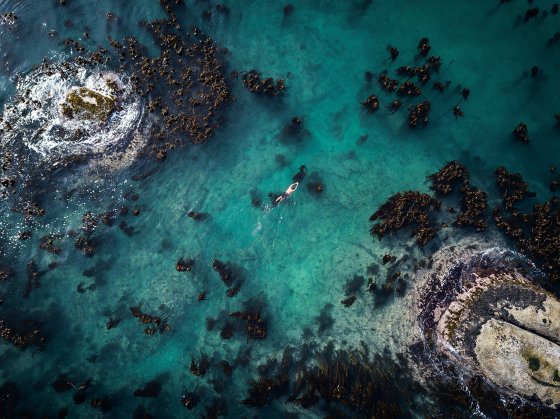
Courtesy of NetflixAerial view of Craig Foster in the Great African Sea Forest.

Rather than go to the desert, he turned to the sea at his front door, and vowed to himself to free-dive every single day for ten years. Braving frigid waters and epic storms, Foster has rigidly kept that commitment. The experience has been transformative, he says. “The cold calms you. It fills your brain with these feel-good chemicals. And then you’re in this golden forest, this liquid environment that hasn’t any gravity. And that becomes your underwater home, especially if you’re visiting it every day.”

It was only several years in that the strange behavior of a small speckled octopus sparked his curiosity, and kept his attention for the duration of her short life. By studying her actions and observing her learn, play and recover from injury, he applied lessons to his own life — even knitting together a fractured relationship with his son.

While Foster documented every dive with a video camera, he did not set out with a plan to make a film. His goal was to better understand the complex ecosystem at his front door, and in doing so, draw attention to what he calls the Great African Sea Forest, a 1200-kilometer-long stand of golden sea bamboo, or kelp, along Africa’s southwestern coast. One of only eight kelp forests in the world, it is vital for ocean biodiversity but little known outside of conservation circles.

In order to safeguard the region, Foster cofounded The SeaChange Project in 2012. “The idea was to get this great African Sea Forest, the home of the octopus teacher, recognized as a global icon, like the Serengeti or the Great Barrier Reef.” He is hoping that the success of My Octopus Teacher, which was backed by his NGO, will effectively brand the sea forest in the popular consciousness. “You have to name a place in order for people to care about and protect it,” he says.

Intimacy with nature

His snack finished, Foster gets up to give a tour of his collections. An old library card catalogue has been repurposed as a specimen case, each drawer containing shells found in the abandoned den of a single octopus. Some octopuses were urchin specialists, others hunted giant turbo snails. As Foster points out a tiny hole in an abalone shell that shows where an octopus has drilled down to get at the creature inside, his quiet reserve disappears. Each item has a story, and he starts tripping over his words in an attempt to tell them all. “This is a helmet shell snail,” he says, picking up a creamy orange spiral. It took him two years of dedicated tracking to figure out how it killed sea urchins, something, he says “even scientists didn’t know.”

One doesn’t need an exotic location (or an octopus) to reconnect with nature, Foster says. While he was fortunate to have the ocean at his doorstep, wildlife teachers can be found anywhere, even in the middle of a city. “If you suddenly took one tree in New York and figured out how that tree changed over 365 days and what animals interacted with it, what insects live in there, how that tree is surviving, I think that could have quite a large effect on your life.”

For Foster, it’s that intimate knowledge that offers real transformation. Just a few months shy of completing his ten-year vow, Foster says he can’t imagine ever giving up his daily dives. He’s not even tempted to dive anywhere else. “The amazing thing is that when you get to know this kelp forest like I have, it’s the most exciting place to dive on earth because you’re just about to solve ten amazing mysteries. You know that crab. You know that octopus, and you just can’t wait to know them better. So I’d actually rather be here than in some exotic place.”

And the discoveries keep coming. Just this morning he found an unusual sea star, one that was blue when it should have been orange. Is it an aberration? A mutation? Or a whole new species? He doesn’t know, but he can’t wait to get back into the water to learn more. As with the octopus that changed his life, “It always starts with these little mysteries… all these mysteries you’re trying to figure out.” With any luck, that sea star may become his next teacher.