martes, 10 de agosto de 2021

New story in Science and Health from Time: Four Civilian Astronauts. Three Days in Orbit. One Giant Leap. Meet the Inspiration4 Crew Four Civilian Astronauts. Three Days in Orbit. One Giant Leap. Meet the Inspiration4 Crew


Jared Isaacman is not likely to forget the day he almost died at 10,000 ft., back in 2011. He was flying closely alongside three others, all in F-14 Tomcats, tearing along at 460 m.p.h. over the desert southwest of Las Vegas.

The group, part of Isaacman’s Black Diamonds aerobatic team, was rehearsing for an air show and trying to come up with a flashy new finish. What they decided on called for flying in a square formation and then suddenly veering toward one another, before pulling back at the last second. It would be a nifty thing to watch go right—and a terrible thing to watch go wrong.

[time-brightcove not-tgx=”true”]

The pilots began the maneuver at their four separate corners and then banked in toward one another. But their coordination was a mess, and the fully fueled twin-engine fighter jets came screaming toward one another.

“Holy sh-t,” exclaimed Isaacman over the radio. He yanked hard on his stick and veered sharply away; the others did the same. Shortly afterward, the Black Diamonds landed, gathered to debrief and reached three conclusions. First, they had gotten too close during the critical approach point. Second, the cause was most likely insufficient lateral spacing at the beginning. Third, they would never try such a high-stakes stunt again. Then they relaxed—and laughed.

Philip Montgomery for TIMEJared Isaacman prepares for a ride in a MiG-29 fighter jet during a crew training event in Belgrade, Mont., on Aug. 7, 2021.

“When you survive it, you can joke about it later,” Isaacman says. “After we debriefed, we were imagining if you were just a hiker in the desert looking up and you’re like, ‘Oh, look at that.’ And then you see this collision. It would be most unusual.”

Most unusual is a decidedly understated way to describe one’s own near-death experience, but Isaacman—now 38 and the billionaire CEO of Shift4 Payments, an online–payment company, as well as the founder of Draken International, a company that runs what’s effectively the world’s largest private air force—has always prided himself on a certain sangfroid. He needed it that day in 2011, and he’ll need it again this Sept. 15, when he’s set to once again be part of a team of four trying something very daring.

This time, Isaacman’s crew won’t be flying at 10,000 ft., but a projected 360 miles up—higher than the Hubble Space Telescope. This time there won’t be four vehicles, but just one: a SpaceX Crew Dragon spacecraft. And this time the fliers won’t be moving at 460 m.p.h., but at 17,500 m.p.h., launched into space atop a 215-ft.-tall SpaceX Falcon 9 rocket.

The mission, dubbed Inspiration4, will mark the first time an all-civilian, non-governmental crew has taken to orbit. To make the mission possible, Isaacman bought all four seats aboard the Dragon for an undisclosed sum (likely in the vicinity of $50 million each). And if he has his way, it will begin to democratize space in a way never before possible.
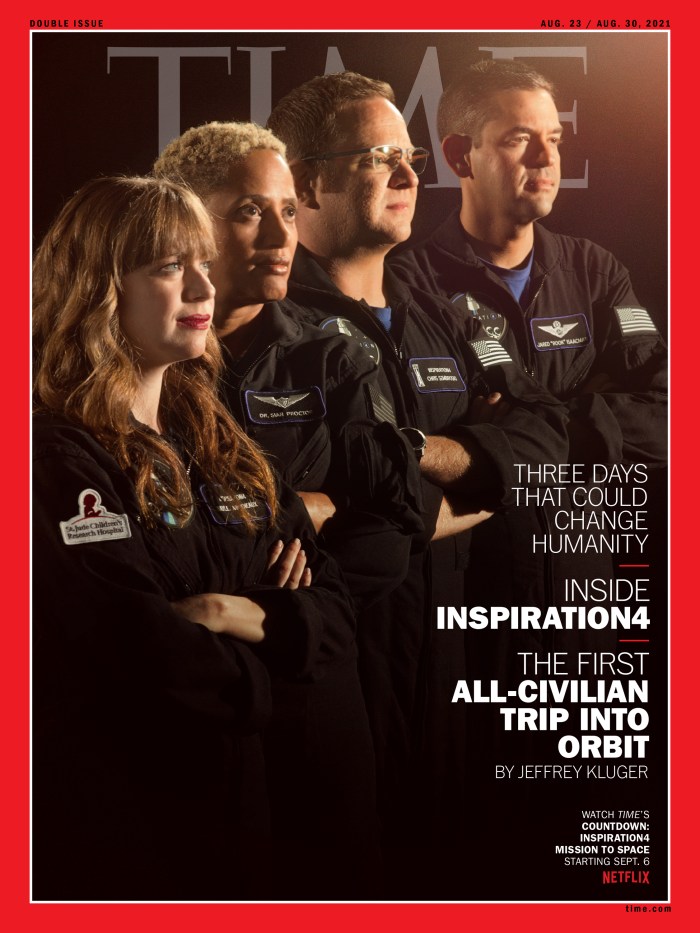
INSPIRATION4 Launch Time Magazine Cover
Photograph by Philip Montgomery for TIME

“I could have just invited a bunch of my pilot buddies to go, and we would have had a great time and come back and had a bunch of cocktails,” Isaacman says. “Instead, we wanted to bring in everyday people and energize everyone else around the idea of opening up spaceflight to more and more of us.”

Isaacman’s mission will be the capstone of what has been America’s summer of civilian spaceflight. On July 11, Virgin Galactic founder Richard Branson flew aboard his V.S.S. Unity space plane more than 50 miles high over New Mexico, crossing the boundary that the U.S. military considers the threshold of space. On July 20, Blue Origin founder Jeff Bezos bested Branson, flying aboard his New Shepard spacecraft above the 62-mile-high mark over Texas—crossing the so-called von Karman line, the altitude that most experts consider space’s true boundary.


There has been much media sizzle around the Branson and Bezos missions, not least because of the “Billionaire Space Race” headlines. But in fact, the pair did not do a whole lot. Their flights were little more than 10-min. up-and-down suborbital lob shots. By contrast, Isaacman and his crew will spend three days in orbit, doing real science on a real mission. The SpaceX Dragon is largely automated, but as Isaacman puts it, “it’s a multiday orbital mission, and there’s just a lot of time for things to go wrong.” So the Inspiration4 crew has been in intensive training in case anything indeed goes wrong.

The business of selecting that crew was as unconventional as the mission itself. The world learned about Inspiration4 from a 30-sec. commercial Isaacman paid to run during the 2021 Super Bowl. The spot announced not only the flight but also Isaacman’s search for three other people to join him. One of Inspiration4’s goals is to help raise funds for the St. Jude Children’s Research Hospital in Memphis, and for that reason one of the four seats would go to a St. Jude employee. (Isaacman aimed to raise $200 million for the hospital; he donated $100 million and has so far raised an additional $13.1 million.) Another seat would be awarded through a simple lottery, which contestants could enter by making a -contribution of any size to St. Jude. The final seat would be a little harder to win, with contenders designing an online store using Shift4 software and then developing a social media campaign to share their entrepreneurial and space aspirations.

The St. Jude worker is Hayley Arceneaux, 29, a physician assistant and a survivor of childhood cancer; she will be the first person to fly to space with a prosthesis—an artificial left femur that replaces the bone she lost to her disease when she was 10. The lottery winner is Chris Sembroski, 41, an engineer at Lockheed Martin in Everett, Wash., and a U.S. Air Force veteran who served in Iraq and who in a later domestic posting helped oversee a fleet of Minute-man nuclear missiles. The winner of the online-store competition is Sian Proctor, 51, a geosciences professor at South Mountain Community College in Phoenix and a two-time NASA astronaut candidate who in 2009 made it to the final 47 out of more than 3,500 candidates before being cut. Now, not only is she going to space, she’s going sooner than she might have on the traditional route. “At least one of the -people chosen in that class in 2009 has not even had a chance to fly yet,” says Proctor.

Yet questions surround not only this mission but also the entire enterprise of civilian spaceflight. For one thing, space travel is expensive—and to many people, the money could be better spent on solving the manifold problems on earth. In an auction for a seat aboard Bezos’ flight, the winner—who later decided not to fly—bid $28 million. That could buy a lot of schoolbooks or feed a lot of hungry people.

Philip Montgomery for TIMEJared Isaacman briefs the Inspiration4 crew before a training session in Belgrade, Mont., on Aug. 7, 2021.

There’s also the question of safety. Space can be a murderous place, a lesson each generation seems to have to learn anew. In 1967, NASA’s Apollo 1 crew died in a launchpad fire that almost scuttled the country’s lunar program. In 1986 came the space shuttle Challenger disaster. Then, in 2003, the shuttle Columbia broke apart during re-entry. More than a few people worry that giddy ambition, human hubris and the limits of technology might conspire once again, just as we’re telling ourselves that the cosmic skies are safe for everyone.

“When there is a fatal accident,” says Terry Virts, a retired NASA astronaut and former International Space Station (ISS) commander, “and I wouldn’t say if, I would say when, that’s going to be a real concern.”

Isaacman sees things differently. “There’s always a risk that something goes wrong, like a structural failure,” he says. “But you have confidence in the whole system and the measures that have gone into place to minimize the risk. Sometimes you land when your knees are clanking together and you say you’re lucky to be alive. But you are—and you move on.”


It’s entirely possible there would have been no Shift4 Payments—never mind Inspiration4—if Jared Isaacman had been a more patient kid. The child of parents who were both on their second marriages, he came into the world with two half brothers and a half sister who are 15, 13 and nine years older. That chafed—not so much the business of being so junior a member of the sibling brood, but, as he reached his teens, at the privileges age afforded his siblings and the ones it denied him.

“They were out living their lives and I still had to raise my hand to use the restroom in school, and I was like, ‘This is ridiculous,’” he says.

Isaacman dropped out of high school in 1999, getting his GED to satisfy his parents. At the time, he and a high school classmate were trying to start their own computer and web business, but getting nowhere. So Isaacman went to work at tech retailer CompUSA, with the idea, he says, “that I could generate business and I could poach some customers.” As it turned out, a customer—a credit-card company called MSI—poached him to solve its IT problems.

“I worked there for about six months, and like a lot of people, I totally disliked one of my bosses,” he says. “I saw an opportunity to do things better and more efficiently, so I left there and started the company that I still run today.”

Isaacman named his new enterprise United Bank Card and slowly began generating a customer base from people he had met at MSI. The new company—which he set up in his parents’ basement—marketed hardware and software allowing restaurants, bars and other businesses to process credit and debit-card transactions, a hot business amid the digitize-everything mania of the late 1990s.

Over the past 22 years, Isaacman’s company has expanded and gobbled smaller firms—including one called Shift4, a name it took for itself (on a computer keyboard, holding shift and hitting 4 gets you a dollar sign). The company, now headquartered in Allentown, Pa., went public last year. It currently has 1,300 employees and a market capitalization of just over $7 billion. Today, if you go into any restaurant or bar in the U.S., there’s a 50% chance your transaction is being processed by Shift4 equipment and software. In hotels, it’s about a 40% chance.

Jared Isaacman and his daughters at their apartment in New York City, July 2021.

But Isaacman, as Shift4 chief of staff Terry Sullivan puts it, “doesn’t do things that sort of normal people do. He’s so full of ambition and just takes on these mountains of projects.”

One of those projects was the unusual business of assembling his own private air force, with over 100 combat jets acquired from half a dozen countries. The force—known as Draken after the Greek word for dragon, was formally founded as a private company in 2011; the U.S. military pays it to fly simulated dogfights with American pilots, training them against the kind of real weaponry that they could one day face in a genuine shooting war.

Draken was an outgrowth of Isaacman’s love of flying, nurtured when he was 12 years old and attended space camp in Huntsville, Ala., where his parents agreed to spend an extra $75 to let him take introductory flying lessons on a Cessna 172. Plenty of people who start with a Cessna stick with a Cessna, but Isaacman was hungrier than that. He eventually got certified in 20 civilian and military jets, including the Soviet MiG-29. He also re-enrolled in school, at Embry-Riddle Aeronautical University, in Daytona Beach, Fla., earning an undergraduate degree in aerospace studies in 2012 while also setting up his Black Diamonds team.

Even before founding Draken and the Black Diamonds, Isaacman was itching to fly much higher. In 2008, he was invited to the Baikonur Cosmodrome—which is in Kazakhstan, but functions essentially as Russia’s Cape Canaveral—to watch the launch of a Soyuz rocket that was carrying Richard Garriott, one of the world’s first paying space tourists.

“It was amazing,“ says Isaacman. “I mean, watching any rocket go up is pretty incredible, but watching a Soyuz go up is something else. You’re in this trench that’s like 300 yd. away—it’s a par 3 away from the rocket. If you’re at Kennedy Space Center, the closest you’re going to get to a rocket going off is like 3⁄ miles.”

The next year, Isaacman approached SpaceX—which at the time was still more than a decade away from carrying its first crews to space—about buying a seat. A draft contract was hammered out, but it took SpaceX far longer than expected to get the go-ahead to fly human passengers, leaving the deal to languish and lapse. But in May of last year, SpaceX finally got its first two-person crew to the ISS, and Isaacman saw another opportunity.

“I think at some point or other, I might fly on one of your rockets,” he recalls telling a senior SpaceX official late last year. (Isaacman declines to disclose the names of any SpaceX officials with whom he has conducted discussions related to his mission.) To Isaacman’s surprise, the official responded directly—and encouragingly. “That may be coming along faster than you might think,” the official said. Indeed it did: four hours later, Isaacman was put in touch over email with the head of SpaceX’s human spaceflight program.

“We understand you might be interested at some point in going on a flight with us,” the program head told Isaacman on a follow-up call. “Well, you could be the first private passenger—and it could be inside of a year.”

The two reached a verbal handshake, and all that was left was for Isaacman to break the news to his family. His wife Monica was not surprised. They’ve been together for 20 years, and she knew this was something he’d been hankering to do for a long time. She agreed straightaway. For the couple’s two daughters, ages 7 and 5, the notion is more fanciful than real. “To them, space is all Baby Yoda at this point,” Isaacman says.


For the Inspiration4 crew, the past five months have been a flat-out sprint to their planned September launch. Isaacman, who assigned himself the position of commander, wants a tight, professional and prepared crew. He personally designed part of the training program, which in part called for flying each crew member in his Soviet MiG-29, exposing them to the kinds of g-forces they’ll experience during liftoff and re-entry. Also on the agenda was a two-day hike up to 10,000 ft. on Mount Rainier in Washington State this past April.

“We got snowed on a lot of the way,” says Arceneaux, the St. Jude physician assistant, who made the hike despite her prosthetic femur. “And our ham-and-cheese sandwiches wound up frozen.”

“The constant plodding upward really did me in,” says Sembroski, the engineer. “My legs were on fire.”

That, in some ways, was the whole idea. “We want to get comfortable with being uncomfortable,” Isaacman says. “A lot of things in the spacecraft will be uncomfortable, after all.”

The rest of their training has mostly involved the usual NASA-style simulator and classroom work, only on a compressed timeline. On a recent day at SpaceX headquarters in Hawthorne, Calif., the crew practiced opening and closing the hatch, what to do in the event of a pressure leak in the hatch seal, techniques for earth observation, and splashdown and recovery procedures—and that was all before lunch.

“I’m used to doing things on NASA time, which gives you two years to train for a mission,” says Proctor. “We have from March to September.”

Once in space, the crew will be kept busy. Proctor will be the pilot—effectively Isaacman’s second in command and responsible for calling up checklists, monitoring systems and executing commands. Sembroski is mission specialist, responsible for repairs as well as proper stowing of cargo to avoid weight and balance issues. Arceneaux is the chief medical officer and will oversee most of the scientific experiments; she’ll take blood samples, for instance, to study the crews’ microbiomes.

Philip Montgomery for TIMEThe Inspiration 4 crew at a training event in Belgrade, Mont., on Aug. 7, 2021.

For all of the mission’s ambition, there remains the question of whether civilian astronauts ought to be flying to space at all. For one thing, the notion that the Bezos, Branson and Inspiration4 flights represent a great opening of the space door assumes that everyone can afford the quarter-million dollars Branson charges or the $50 million or so that the Inspiration4 seats probably cost. It’s possible that costs will fall as the industry grows. But even if the price tag of a Branson mission were slashed by 80%, that’s still $50,000 for 10 minutes in space.

Then there’s that matter of whether that money could be better spent on earth. Of course, any single dollar spent on any enterprise—Silicon Valley tech, auto manufacturing, sports stadiums—could instead be spent on humanitarian causes. Yet space, to many, feels more frivolous, and thus gets hit harder by critics. But some say the case against space spending doesn’t hold up.

“These people—Bezos and Branson and Isaacman—aren’t spending money on themselves,” says John Logsdon, the founder of the Space Policy Institute at George Washington University. “They’re spending money to create a business; these are business investments that create jobs and bolster the economy. If they’re successful, they’re risking their own money to build those businesses. Well, that’s capitalism, right?”


There’s also the question of safety. Isaacman often points out that it took only 12 years after Charles Lindbergh’s solo trip across the Atlantic before Pan Am introduced commercial transatlantic service. But physics has a say in this too. Commercial air service does not require the 4.9-mile-per-second speeds it takes to orbit earth, it does not regularly subject passengers to four g’s, and it does not require passengers to climb atop the controlled bomb that is a Falcon 9 rocket. People have died in space; people have died merely trying to get to space—but always in the service of a larger scientific and geopolitical mission. If people die in the service of something that seems less noble, the space market as a whole could dry up as fast as the dirigible business did following the Hindenburg disaster.

That kind of mortal danger attends all space flights, but Isaacman and his crew seem to have already priced it into their thoughts about the mission. They say they are confident that the hardware they’re flying will take them to and from space safely. And with good reason: the Falcon 9 rocket has been successfully launched more than 120 times, and while the Crew Dragon is a newer spacecraft, with only three crewed missions, it has flown admirably so far (Dragon has also flown more than 20 equally successful uncrewed missions).

“I have so much faith in our SpaceX team that I’m not nervous about a poor outcome,” says Arceneaux. “I’ve met the lead engineers for every aspect of our mission, and they know what they’re doing. Inspiration4 is in wonderful hands.”

Isaacman is equally confident. “You just accept there’s a very, very low probability of something going wrong,” he says.

He should know. He’s come back from harrowing flying before—and space, he’s convinced, is an order of magnitude safer than air shows. His concern, he says, is more about performance. If Inspiration4 won’t in fact kick the door to space travel wide open, allowing the rest of us to pour through after, it can at least crack that door, coming just a little closer to normalizing rocket travel and democratizing space. For Isaacman, that carries with it not just a responsibility to his crew, but to history to get the mission right.

“I am constantly thinking about good execution,” he says. “We have to fly well; we have to earn the right to be here.”

(TIME Studios is producing a documentary series on the Inspiration4 mission.)

Read More About the Inspiration4 Mission:

New story in Science and Health from Time: Meet the All-Civilian Crew of Inspiration 4, From a St. Jude’s Physician Assistant to a Lockheed Martin Engineer Meet the All-Civilian Crew of Inspiration 4, From a St. Jude’s Physician Assistant to a Lockheed Martin Engineer


Astronauts are accustomed to celebrity status, and Jared Isaacman, 41, is learning that truth first-hand. Isaacman is the billionaire CEO of Shift4 Payments, an online payment company, who bought all four seats aboard a SpaceX Crew Dragon spacecraft and, come September, will command Inspiration4, the first space mission crewed entirely by non-professional astronauts.

But if Isaacman’s name is becoming increasingly well-known in space circles, those of the other crew members are less so. Here’s a look at who they are, how they were selected to make their improbable journey, and what they hope to accomplish while aloft.
[time-brightcove not-tgx=”true”]

Sian Proctor

Philip Montgomery for TIMEDr. Sian Proctor of the Inspiration4 crew, the world’s first all-civilian mission to orbit.

Two of the most memorable moments in Sian Proctor’s life involved a phone call—though the first she’d just as soon forget. That one came in 2009, when she was in contention for selection as a NASA astronaut. It was her second attempt, and while she hadn’t gotten very deep into the selection process the first time around, this time she was one of 47 candidates remaining out of 3,500 who had applied. Then came the call from NASA’s astronaut office.

“It was the yes-or-no call,” Proctor says. “And for me it was a no.”

Twelve years later, things were decidedly different. Like millions of other people, Proctor, 51, learned about Inspiration4 via a TV ad that ran during the 2021 Super Bowl announcing both the mission and that Issacman was seeking three crewmates to fly along with him. One of the seats was reserved for a worker at St. Jude Children’s Hospital in Memphis, Tenn. (the mission is in part raising funds for the hospital). One of the other two crewmates would be chosen via a simple lottery. The last was determined by a contest in which contenders designed an online store using Shift4 Payments’ software and shared their entrepreneurial and space aspirations via social media. That was the route Proctor chose, and within two weeks of submitting her proposal, she got an email inviting her to a Zoom call. When she logged on, she found Isaacman at the other end.

“Jared was very direct,” Proctor recalls. “He just said, ‘We’ve selected a winner. It’s you.’”

The choice was apt in all manner of ways. Proctor was born on Guam, the daughter of an engineer who worked at the NASA tracking station there during the Apollo 11 mission—the first lunar landing. She grew up admiring the framed, autographed note Neil Armstrong wrote her father. It said simply: “To Ed – Thanks for the help.”

That was enough to light the science fires in Proctor, who went on to earn a bachelor’s degree in environmental sciences, a masters in geology, and a PhD in science education. She now teaches geoscience at South Mountain Community College in Phoenix. But space was always tugging at her. In 2020, she participated in a four-month simulated Mars mission at a habitat run by NASA and the University of Hawaii on the flank of the Mauna Loa volcano meant to study crew cohesion. But Proctor still longed for the real space deal—and now she has her shot.

“I thought a commercial mission like this was a decade away,” she says. “But as it turns out, the moment is now.”

That moment will go quickly for Proctor, if only because she will be kept very busy during the three days she’ll be in space. Though Isaaacman is the commander, Proctor has been designated the mission pilot and will take the lead in calling up checklists and monitoring systems. Any command Isaacman issues, she’ll verify and execute. IfIsaacman is away from the controls at any moment, she will step in, oversee the spacecraft and communicate with Mission Control. Even as she trains, she continues to work for her community college, curating art and poems she will take to space with her.

Proctor will have academic responsibilities in space as well. In one of her rare free periods, she hopes to teach a science lesson from space, parlaying her professorial skills to help promote both the mission itself and the larger goal of advocating for civilian space flight. And then, too, there will be one personal goal she plans to achieve: in a symbolic thank you to her father, who died in 1989, and a sort of closing of a life circle, the letter from Armstrong will accompany her to space.

Chris Sembroski

Philip Montgomery for TIMEChris Sembroski of the Inspiration4 crew, the world’s first all-civilian mission to orbit.

Here’s how you tell your spouse you’re going to go to space—or at least here’s how you tell your spouse if you’re Chris Sembroski, 41, a man of admirable directness. “Sweetheart,” he said, after he got the call from Isaacman that he’d been tapped for Inspiration4. “I think we’re gonna go ride a rocket.” His wife responded with a shocked, “What?” recalls Sembroski, who adds: “Then she got really quiet, and I knew we had more to discuss.”

Sembroski and his wife almost never had to have that discussion. He won his seat aboard Inspiration4 by making a donation to St. Jude and entering the mission lottery. Good fortune first passed him by, however, when someone else’s name was pulled from the hat. But good fortune wasn’t done with Sembroski.

The person who won the contest was Sembroski’s closest friend and the best man at his wedding. For personal reasons, they decided not to go and, almost as an afterthought, suggested to Isaacman that maybe Sembroski could fly in his place. Isaacman agreed.

The commander of the mission made the right choice, because Sembroski is decidedly well-suited to make the trip. A one-time space camp counselor who built high-power model rockets as a child, Sembroski attended Embry-Riddle Aeronautical University in Daytona, Florida, where he earned a bachelor’s degree in professional aeronautics. He served in the U.S. Air Force, both in the Iraq War and later in a domestic posting attending to the white knuckle business of maintaining a fleet of nuclear Minuteman missiles. He also volunteered his time with ProSpace, a nonprofit lobbying group advocating for the very legislation that opened up the private spaceflight market to companies like SpaceX and Blue Origin. He now works as an aerospace engineer at Lockheed Martin in Everett, Wash.

Like the rest of the Inspiration4 crew, Sembroski has been devoting much of his time lately to training to be a citizen astronaut. Along with his crewmates, he’s working 60-hour weeks in the simulator and the classroom at SpaceX headquarters in Hawthorne, Calif., and spending his ostensible off-hours deep in briefing books and conference calls. The homework involves matters as grave as how to handle emergencies like an on-board fire and as mundane but essential as the crew’s sleep and meal schedules. Once in space, Sembroski will serve as the payload specialist, seeing to cargo, making repairs and serving as technical expert on some of the systems.

I am still learning culture and processes,” Sembroski says. “Finding where I am going to apply my stamp of expertise is my biggest focus right now.”

At the same time, he’s also trying to make time for family. The father of two girls, ages nine and three, Sembroski is determined not to tumble so deeply into his work that he loses track of them and his wife—a goal made all the harder to achieve as he is not on leave from his day job, though his employer has made come accommodations for his training schedule. “If I am constantly on my phone or checking email, am I really there and in the moment spending time with them?” he says. “It is important that I am with my family when I am with my family.”

And as for the mortal fear every person who goes to space must find a way to face—the risk that the outbound journey may not end with a safe inbound journey, that that well-loved family will be left bereft? Sembroski, like every person who has ever gone to space before him, has found a way to make peace with that risk, though he’s concerned with another worry.

“The biggest fear I have is not related at all to the rocket itself,” he says. “The biggest fear I have is that this sacrifice and time spent away from my family results in very little change in me. If the narrative behind this becomes nothing more than, ‘Oh, yeah, there was this one time when I flew into space,’ then I will have felt as though I wasted this opportunity.”

Hayley Arceneaux

Philip Montgomery for TIMEHayley Arceneaux of the Inspiration4 crew, the world’s first all-civilian mission to orbit.

The pain in Hayley Arceneaux’s left knee began when she was 10, and at first she tried to shake it off. She was a child, children get banged up, and something or other is always hurting. But she wasn’t banged up and the knee didn’t stop hurting and her parents eventually took her to the doctor—who was blunt in his diagnosis.

“This is bone cancer,” he said.

“I don’t want to die,” Arceneaux answered.

Twelve rounds of chemotherapy at St. Jude followed—the last of which was celebrated with confetti—and Arceneaux emerged from her illness with an artificial knee and a prosthetic bone in place of her left femur, as well as with a commitment not to be slowed down by her circumstances. Even while a patient at St. Jude, she volunteered as an assistant receptionist in the blood donor department.

“Thank you,” she would say to donors. “If I didn’t get blood platelets I would shrivel up.”

After her treatment was done, Arceneaux returned to school, earned her undergraduate degree in Spanish and, in 2016, got her physician’s assistant degree and began working at the very hospital that saved her life. Only one goal eluded her: she promised herself she would visit every continent by the time she was 30—the age she turned this year—and while she made it to five, the last two, Antarctica and Asia, will have to wait, because she is going to space instead.

Isaacman knew from the start that he wanted a St. Jude employee along on his mission. When he approached the administrators there, they enthusiastically recommended Arceneaux. Unlike Proctor and Sembroski, she did not get the news from Isaacman himself, but from St. Jude staffers who told her they had what they called “a unique opportunity” for her. She suspected it was a TV commercial or perhaps a speech they wanted her to deliver. When they told her what they actually had in mind, Arceneaux demurred.

“I should check with my Mom,” she said. Her mom said yes and Arceneaux became part of the Inspiration4 team, tapped to serve as the mission’s chief medical officer and also to conduct many of the on-board experiments. During her training, she is also using her newfound celebrity to continue publicizing and fundraising for St. Jude.

Flying to space won’t be easy—and flying to space with a prosthesis, something no one has done before, will make things more challenging still. Arceneaux earned a black belt in taekwondo before she got sick, but since then, she has been forbidden to play contact sports for fear of damaging her prosthesis. She worries about the effect the g-forces during lift and reentry will have on the artificial femur—though she has already made it through centrifuge training with no ill effect. If she fares as well in the mission itself, she thinks she may be able to change the very standards used to judge future astronauts.

“People who went to space in the past had to be perfect physical specimens,” she says, “and that’s not the case anymore. I’m going to be the first pediatric cancer patient to go, but I won’t be the last.”

Indeed, she is already doing what she can to make that prediction a reality. “A girl at the hospital told me that she can’t run or jump,” she says. “I told her, ‘I can’t run or jump either, but that’s not stopping me from going to space.’”

(TIME Studios is producing a documentary series on the Inspiration4 mission.)

Read More About the Inspiration4 Mission:

New story in Science and Health from Time: St. Jude’s Fundraising Chief on Space Missions, ‘Pushing Boundaries’ and a Record-Setting Year St. Jude’s Fundraising Chief on Space Missions, ‘Pushing Boundaries’ and a Record-Setting Year


St. Jude Children’s Research Hospital, which looks after children with cancer while also researching how to eliminate the pediatric form of the disease, raised a record-breaking $2 billion in donations in its last fiscal year. It’s a record for an independent charity, and an impressive feat in a year when donors had more causes than ever vying for their attention and money.

Richard Shadyac, the CEO of the American Lebanese Syrian Associated Charities (St. Jude’s fundraising organization), attributes that success to a nimble pivot to different fundraising strategies—one of which was a collaboration with Inspiration4, the first space mission crewed entirely by civilian astronauts. That partnership brought in not only $100 million promised by Jared Issacman, the mission’s billionaire commander of the flight, but a further $16 million through such initiatives as a sweepstakes to win a chance at joining Issacman as part of his crew
[time-brightcove not-tgx=”true”]

TIME recently spoke with Shadyac about the stratospheric challenges of the mission to raise money. The following is lightly edited for length and clarity.

Are there some ways in which solving the puzzle of childhood cancer is a little bit like sending a civilian astronaut to space?

St. Jude has always been about pushing boundaries and taking what seems like impossible and making it possible. Our founder [comedian Danny Thomas] determined that he was going to tackle an incurable disease called leukemia. It had a survival rate of 4% and it was the most common form of childhood cancer. Fast forward almost 60 years and the survival rate is now 94%. It seems impossible that four civilians could go into space and orbit the earth, right? And that’s exactly what’s going to happen. Now, the goal is tackling global cancer; the survival rates in low and middle income countries are 20% or less. So, that’s the current problem that we’re trying to solve, which I think is akin to four civilians being shot into space.

(TIME Studios is producing a documentary series on the Inspiration4 mission.)

One way that you could raise the funds you’ll need, people might suggest, would be using the money that these billionaires are spending on going to space. What would you say to those people?

I would say that it’s a both-and. Jared Isaacman has made a $100 million commitment to us. So I would say that Jared is helping to solve this multi-trillion, multi-year problem that global cancer is. For us, it’s both a revenue strategy, and an awareness strategy. It has allowed us to get in front of different audiences. We know that many of the people who participated in this drawing tended to be on the younger side. So it brought some of those people who may not have gravitated toward our mission.

In April 2020, you said that, like nearly every nonprofit, you were being profoundly affected by lost financial support. But then 2021 was a record year. You raised 2 billion dollars. How did that happen?

Whether you were a for-profit CEO or not-for-profit CEO, when we were all going into this pandemic, none of us had ever experienced a pandemic before. It looked like we were going to be taking a material hit from a revenue perspective. We couldn’t do in-person events, just to give you one example. We had been building up our digital fundraising capabilities, and then some very smart people that work for me talked about ways that we could reach our supporters where they were. We knew where they were; they were home. So we employed every method that we could possibly employ to reach them at home, to get our message across, to see if they wanted to support our mission. Those terrible kind of estimates that we were making for revenue actually turned out to be false and we did incredibly well.

You worked with places like Twitch and Strava, which people don’t really think of as networks where donors hang out. How did that work?

I actually am looking for different audiences that could support our mission. Up to 68% of our revenue comes from households with incomes of $75,000 or less. That would include young people and gamers. Our typical donation is in the neighborhood of about $43 to $45. We have 11 million donors. This wasn’t the first year that we had been working with influencers and gamers. Their audiences trust them. So when Matt Pat or Dr. Lupo and his wife would speak, their audiences believed St. Jude is a cause you need to get behind.

What do you say to people who think that curing cancer is not a problem for charity, it’s a problem for the medical industry to solve?

Sadly, business hasn’t stepped up to solve the problem of pediatric cancer. There’s very little investment from Big Pharma in pediatric cancer. Why? Because kids are a “customer base” of zero to 18. Would you rather work on a problem with a population from 0 to 18 or from 18 to 88?

In 2020 we developed a vaccine for COVID-19, did enough testing on it that the U.S. Food and Drug Administration would give it provisional approval, and figured out how to manufacture it and distribute it within 16 months. I wondered if it leaves charities that deal with other diseases thinking, “um, could we not do this for the disease we’re fighting?”

I dream about that all the time and wonder why it’s taken us as long as it has. But as I talked to doctors and scientists around the world, this is just an incredibly complex problem. Through the work with our pediatric cancer Genome Project, we’ve now found out that there are many, many subtypes of these diseases, and they’re all very different, and where a child is in terms of its development can affect its ability to survive these diseases.

Apart from genomics, you are raising money for such research as proton therapy, immunotherapy and structural biology. Is there one that you find most compelling?

I think it’s attempting to solve the global childhood cancer problem. In the United States, St. Jude has helped take the overall childhood cancer survival rates from 20% to 80%. Why can’t we do that around the world?

But in developing nations, more kids are dying of diarrhea than cancer. Should we not address the easy one first?

We can do two things at one time. We take for granted in this country the access that we have to health care. That’s why the pandemic is so frustrating right now. There are therapeutics, there is a vaccine, but around the world they don’t even have access to the COVID vaccine. It’s very frustrating to listen to the debates here in the United States, when you take for granted the access that we have to this incredible health care here.

You’ve been in philanthropy in some way your entire life. What would you like to see and what has surprised you about the way philanthropy works now?

It doesn’t surprise me, but I’m disappointed that our industry hasn’t invested more in technology and digital fundraising. I think that there’s been some lost opportunities at some of our sibling charities. What helped us weather this pandemic was that we were able to reach many of our supporters [digitally], and to pivot to virtual events. I genuinely believe that the next frontier is going to involve artificial intelligence, machine learning, augmented reality and virtual reality. I wish our industry would take more advantage of it. We cannot rely upon old legacy thinking; we really need to develop sustainable business models that constantly iterate and change to meet people where they are. We raise tens of millions of dollars on Facebook. We’re the number one charity of choice on Amazon Smiles. We know people are going to use Amazon and Facebook. So why not give a little bit of money back or do a fundraiser for the charity of your choice?

As this generation of tech billionaires begin to enter their leave-a-legacy phase, do you worry or celebrate the outsized power they have to make change?

I worry about outsized influence and that we might not pursue the problems that are the most pressing. I worry about those very large investments in charities that might not have the ability to actually appropriately spend that money. But I also worry about this: those models are not sustainable. MacKenzie [Scott] is amazing. Absolutely incredible. But she can only do that for so long. It’s so much more important that you have 11 million donors; that’s sustainable. That’s going to be there when that big donation actually runs out, that’s how you can make an impact and make progress in your mission. We all have to make sure that we build organizations that are sustainable for the long haul, because solving these problems takes years.

Read More About the Inspiration4 Mission:

lunes, 9 de agosto de 2021

New story in Science and Health from Time: The Latest IPCC Report Says We’re Probably Going to Pass the 1.5°C Climate Threshold. What’s Next? The Latest IPCC Report Says We’re Probably Going to Pass the 1.5°C Climate Threshold. What’s Next?


Three years ago the United Nations climate science body issued a landmark report warning that the planet was on track to blow past efforts to limit global warming to 1.5°C above preindustrial levels, a threshold that it warned would bring catastrophic and irreversible effects of climate change. But in that same report, the Intergovernmental Panel on Climate Change (IPCC) emphasized that many paths remained open for us to limit that damage—so long as we acted immediately.

On Monday, the IPCC published a new document with a far less optimistic frame. In it, the group says that the pathway to limit warming to the 1.5°C mark has narrowed and lays out only one plausible scenario to meet that goal—one that would require an extraordinary level of action, and even then, would offer no guarantee.
[time-brightcove not-tgx=”true”]

“It is still possible to forestall many of the most dire impacts,” says Ko Barrett, a vice chair of the IPCC, and deputy assistant administrator for research at the U.S. National Oceanic and Atmospheric Administration. “But it really requires unprecedented transformational change, [and] rapid and immediate reduction of greenhouse-gas emissions.”

Documents like this can be disheartening—in fact, they probably should be. The report, the first in a string the IPCC plans to release in the coming months as part of its sixth Assessment Report, covers the latest science on physical impacts of climate change and runs through a long list of areas where science has definitively established that humans are wreaking havoc on the planet, from the way water circulates across the planet to thawing permafrost.

But the report also offers a reminder that, in the words of Hoesung Lee, chair of the IPCC and professor in the economics of climate change, energy and sustainable development at Korea University, “every bit of warming matters.” No matter how bad things are, policymakers, businesses and individuals can avoid making the situation worse with urgent action.

If you’ve followed climate news recently, the substance of the new IPCC report probably won’t come as much of a surprise. For years, alarming headlines have created a sort of drip of bad climate news, and in recent weeks, droughts, storms and fires have coalesced into one of the most cataclysmic seasons of climate-related extreme weather events in memory.

Even a few years ago, scientists were not entirely comfortable drawing the connection between such events and climate change. But that’s been changing, and the IPCC’s endorsement of those connections gives the concept a gravity that only such a global body can provide. The document is the result of a collaboration between 234 different authors, and draws from more than 14,000 different studies and references. In the end, delegations representing nearly 200 countries agreed to the language—even those whose economies depend on fossil fuels. Ultimately, all of those signed on to the conclusion that human-caused climate change is an “unequivocal” reality.

The list of changes that comprise that broader reality is long. To name a few examples: The report found that human-induced warming has already locked in up to a foot of sea-level rise by 2050 (in terms of the global average). It also shows that every region on Earth is already experiencing some sort of weather and climate extreme—some are suffering more severe heat waves, while others are figuring out to endure unfamiliar storms and precipitation levels.

All of these problems are bound to get worse. With unchecked greenhouse gas emissions, sea levels could rise six feet by 2100, according to the report. The frequency of high-powered hurricanes would spike. And regions across the globe would see hotter and rainier days, and more of them.

Some consequences are hard to predict, particularly as humans take the planet further away from the temperature levels of recent millennia, but the report explains in clear terms that the degree to which it gets worse is directly linked to how much temperatures rise, which in turn is directly linked to how much carbon dioxide humans spew into the atmosphere.

The report breaks down five scenarios designed to illustrate plausible pathways by which temperature rise and carbon dioxide emissions may unfold. In all scenarios, from the the most high-emissions scenario presented in which humans do little to slow emissions to the most aggressive scenario in which humans act urgently, temperatures are likely to rise 1.5°C within the next two decades. This is the result of a simple fact: the warming we’re experiencing now is the result of emissions that happened decades ago and we’ve already locked in decades more.

But from there the situations diverge significantly. If humans act urgently, temperatures will peak and then decline, helping stabilize the planet and life on it. If we allow emissions to continue unchecked, temperatures are likely to rise more than 4.4°C by the end of the century—a level that would make life unlivable on vast areas of the planet.

In one sense, this is bad news. Barring a dramatic change in direction that would entail dramatic changes in policy, the planet is likely to pass the so-called red line that scientists and activists have drawn in the sand. But this dynamic—where humans emit and the planet responds—should also offer some motivation as negotiators representing virtually every country prepare for COP26, the U.N. climate conference in November. Ahead of that conference, each country is expected to come up with its own plan to tackle emissions that align with the 1.5°C goal, and commit to those policies on the global stage. On July 31, the U.N. body that organizes international climate talks said that just over half of countries had submitted new plans to reduce emissions and warned that those policies would still push the world past 2°C of arming—and that’s a best cast scenario that assumes countries follow through.

IPCC scientists say they expect negotiators to keep the latest report in mind. We may be close to passing the red line, but we can control how much worse things get afterwards. “We can’t undo the mistakes of the past,” says Inger Andersen, the head of the United Nations Environment Programme. “But this generation of political and business leaders, this generation, conscious citizens can make things right.”